
God Geometrizes Continually
Reflections on Geometry, Scale, and being a Fellowcraft

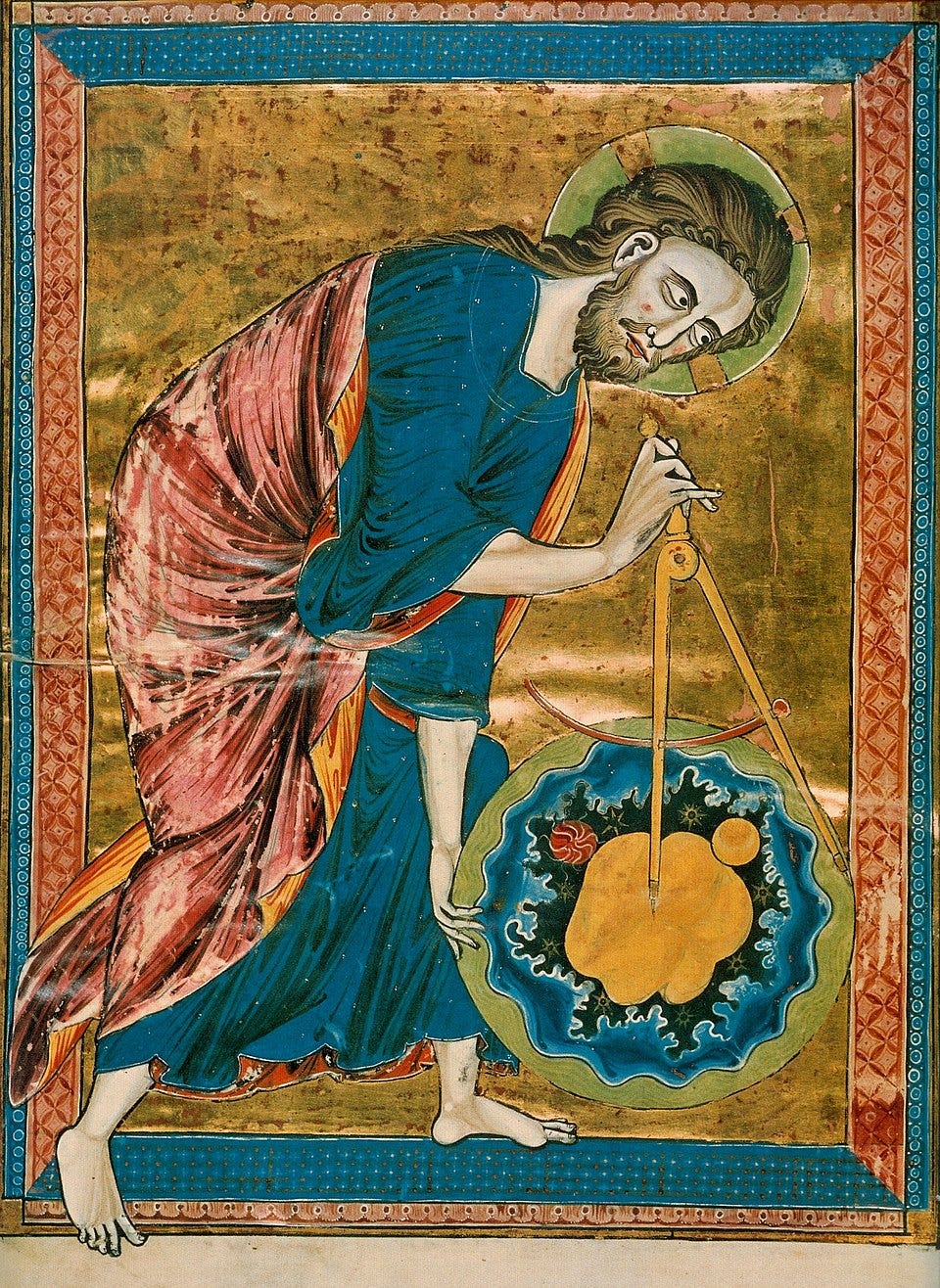
After each of our degrees, my lodge holds what we call “Harmony,” a time to sit down with a newly initiated, passed, or raised brother and discuss the degree and lectures they experienced and heard earlier in the evening over a meal. For the past few years, I have given the “G Lecture” for my lodge, and I am always asked what I have taken away from that lecture in my time studying and memorizing it. The below is an attempt to explain some of what I’ve taken away from that lecture over the years. I hope you enjoy it.
"Let no one ignorant of geometry enter here."
— Inscription at Plato’s Academy
The Fellowcraft stands upon the threshold of the Middle Chamber and observes suspended in the East the letter G. This symbol has for centuries arrested the attention and compelled the reverence of the initiate. It is the initial of Geometry, the first and noblest of the sciences, and it is the monogram of God, the Grand Architect of the Universe. To the superficial mind, these two significations often remain distinct and separate. Science appears as one thing: cold, analytical, and material; concerned only with the properties of dead matter and the mechanics of force. Religion appears as another: warm, intuitive, and spiritual; concerned only with the aspirations of the soul and the dogmas of faith. It is the peculiar and high province of Freemasonry to unite them. We seek to bridge the artificial chasm between the altar and the laboratory and to demonstrate that they form two pillars supporting the same Arch of Truth. We teach that in the highest view, Geometry is the handmaid of the Deity. It is the very method of His action and the language in which He has written the laws of the universe upon the vast page of the firmament and the minute page of the atom. We are taught that the universe stands as a Temple, built by rule, laid by the level, and squared by the square. Every stone is a star; every arch is a galaxy. To study the proportions of this Temple is to approach the mind of its Builder and to comprehend that the laws of Nature are but the materialized thoughts of God fixed in substance and extended in space.
When we consider Geometry, we move beyond the measurement of fields or the erection of walls, though these are its useful applications in the operative art which gave birth to our symbolism. We speak of that Divine Science which occupies the intermediate station between the Intelligible and the Sensible. By the Intelligible, we mean that high realm of pure thought, spirit, and changeless truth which the eye cannot see but the mind can conceive. By the Sensible, we mean the material world of matter, flux, and physical sensation. Geometry serves as the vestibule of the Good. It acts as the screen upon which the indivisible truths of the Divine Intellect are projected into the divisible forms of the imagination. As the mind descends from the purity of pure Intellect, where all things are One, it encounters the necessity of Extension. Here the Point appears as the emblem of the Monad: the indivisible One, the source of all number and form, possessing position but no magnitude. The Line, flowing from the Point, represents the Dyad or the process of Emanation: the movement from unity into duality, from rest into motion. The Surface represents the descent into Form, where the idea gains a face, a limit, and a definition. The Solid represents the full manifestation in Matter: the crystallization of the Divine Idea into the physical world. Thus geometric figures function as hieroglyphs of the process of Creation. The Triangle is the first born of the side and the diagonal, the image of the Triad that governs the Soul. The Square is the image of the Tetrad, the stable foundation of Nature. The Circle is the image of the Eternal Return. The ancient philosophers of the Porch and the Academy well understood this. They inscribed over their portals that none ignorant of Geometry should enter, for they saw that without a knowledge of these fundamental laws, the mind was incapable of grasping the abstract truths of philosophy.
Pythagoras, who brought the light of the East into Greece, taught that the universe was governed by Number and that the movements of the heavenly bodies created a harmony. According to the symbolic cosmology of his school, he perceived that the same ratios which govern the musical scale: the octave (2:1), the fifth (3:2), the fourth (4:3), etc; governed the distances of the planets and the periods of their revolution. This bound music, mathematics, geometry, and astronomy into one “Quadrivium” of cosmic order which descended from the One to the Many. This harmony extends inward to become a pattern for the internal governance of the soul. As the strings of the lyre must be tightened to the correct tension to produce a melody, so the passions and faculties of the man must be “tuned” by the ratios of virtue to produce a life in harmony with Heaven. Plato, who drank deep from the fountains of Egyptian and Pythagorean wisdom, asserted that “God geometrizes continually.” This sentence contains within itself the whole philosophy of our Order. It implies that the Creative Energy acts by a steady, immutable Law. The Universe is a thought of God manifested in forms of mathematical precision, from the spiral of the galaxy turning in the silence of the void to the spiral of the snail’s shell hidden in the grass of the field.
This conception places the human soul in a precarious position. It is suspended between the Indefinite Dyad of the Great and the Small: the two terrifying abysses of the Infinite. The 17th-century mathematician Blaise Pascal, whose intuitions bordered on the Masonic, confessed that “the eternal silence of these infinite spaces frightens me.” He saw man as a “thinking reed,” poised perilously between the Nothing and the All, perceiving both but master of neither. Indeed, if we look outward through the telescope, we are confronted by the unfolding of the Infinite Procession. We see the solar system, which to the ancients seemed the sum of things, reduced to a mere speck in a galaxy of millions of suns. That galaxy is but one of millions more, drifting like dust motes in the sunbeam of an infinite ether. The distances are such that the imagination reels and staggers in the attempt to traverse them. Light itself, the swiftest of messengers, grows weary in the journey from star to star. The times are such that the life of a man, or even the duration of an empire, is but the ticking of a second in the year of God: a fleeting breath in the Great Year of the Precession. In this vastness, where the Earth is a grain of sand and man an invisible animalcule upon it, we might well despair of our significance. We might feel that in such a limitless theater, the drama of human morality is a farce, and our joys and sorrows but the tremors of a leaf in a hurricane. Yet the Compass of the Fraternity reminds us that even this illimitable extension is circumscribed by the care of the Grand Architect. Size is not the measure of worth. The Soul, which can comprehend the Galaxy, is greater than the Galaxy, which knows not itself.
But if we turn our gaze inward, we encounter an abyss no less deep and no less infinite: the abyss of infinite divisibility. We apply the microscope not only to the earth beneath our feet but to the tabernacle of our own flesh. We find that we are not simple unities but vast commonwealths of life. The blood that courses through the veins obeys the same hydrodynamics as the tides of the ocean; the intricate lattice of the nerves transmits the mandates of the will with a speed and precision that rivals the lightning. Within the citadel of the skull, a billion cells weave the tapestry of thought and create a universe of memory and imagination that spans the ages. Each of these microscopic lives performs its duty with a fidelity that shames our conscious negligence. They build, they repair, and they sustain the temple of the body without pause or complaint. This internal landscape reveals that we are composed of myriads of separate lives bound together by a mysterious unity we call the Self. Just as the galaxy constitutes a dust of stars, so the man constitutes a dust of atoms organized by the same Divine Law. We recognize that the mystery of the Grand Architect is not only that He built the macrocosm, but that He fashioned the microcosm with equal care.
We find this truth enshrined in an elaboration of the Second Degree, known to the brethren of Mississippi as the “Dew Drop Lecture.” This catechism, handed down from a generation before our own, preserves a vision of the cosmos where the Divine Geometer operates with equal precision upon the smallest and the greatest scales. It reminds us with a singular beauty that the same Geometry which rules the stars presides over the humblest aspects of nature. By Geometry, the Almighty Architect rounds the dew-drop that glistens on the leaf. He shapes it into a perfect sphere by the same law of attraction that rounds the planets and binds them in their orbits. In the higher philosophy of the ancients, the Sphere is the image of the Intellect returning upon itself: perfect, self-contained, and without beginning or end. Thus the humble drop of water mirrors the perfection of the Divine Mind. By the same geometry, He points the pyramidal icicle that hangs from the thatch-bound roof. He creates the delicate frost-work on the window-pane, which mimics the foliage of the forest, revealing the hidden sympathies between the mineral and vegetable kingdoms. He instructs the bee to construct her cell in the hexagonal form: the most perfect figure for economy of space and strength. He paints the bow of beauty upon the canvas of the summer shower, bending the light into the arc of a circle: the symbol of the Covenant between the Limit and the Unlimited.
Consider the seed, which holds within its microscopic geometry the architectural plan of the mighty oak. The folded leaves, the spreading branches, the future roots; all lie coiled in an invisible ratio within the germ. Consider the crystal, buried in the dark cavern. It arranges its atoms in lattices of faultless symmetry, obeying a law it cannot know, building cathedrals of silica and temples of salt in the silence of the earth. Consider the eye of the insect, a compound jewel of geometric facets, each one a window onto the world. Nothing is too small to escape the rigor of His law. Nothing is so minute that it does not bear the signature of the Great Geometrician. The dust of the balance is weighed as carefully as the bulk of the sun. The death of a sparrow is marked in the ledger of Providence as surely as the fall of a dynasty.
We find, therefore, that the Divine Intelligence is as present in the organization of the mite as in the revolution of the sun. The Infinite exists both in the cold reaches of space and woven into the texture of the smallest particle. This double vision, initially a source of terror, becomes for the Mason a corrective to his own nature. It cures the soul of two errors: the error of Pride, which imagines man to be the master of the world; and the error of Despair, which imagines him to be lost in it. We stand in the “Meso-scale,” the middle ground, the isthmus between these two infinites. It is the peculiar dignity of the human form and the human mind to occupy this central station. We are the meeting point of the two worlds: the nexus where the Spirit touches Matter. We have feet of clay, rooted in the microscopic chemistry of the soil, subject to the laws of heat, gravity, and decay. We have heads of gold, lifted toward the abstract laws of the heavens, capable of comprehending the Infinite and communing with the Eternal. To lose this equilibrium is to fall into error. The Materialist, obsessed with the dust and the mechanism of things, forgets the star and becomes a beast; he grazes upon the earth with no thought for the sky. The Fanatic, obsessed with the abstract and the visionary, forgets the brother who stands at his side and becomes a phantom; he is useless to the world of men. Between these two ruins stands the Mason. He represents the synthesis of faith and science: a man fully alive in the world of the senses, yet a builder of it according to the laws of the spirit. He works with the trowel of the active life, yet he guides it by the eye of the contemplative life.
“This is none other than the house of God, and this is the gate of heaven.”
— Genesis 28:17
To cultivate this balanced builder, Masonry, in its wisdom, constructs the Lodge as a model of the Universe. It is a sanctuary scaled to the human dimensions to counter the terror of the void. In the profane world, man is often overwhelmed by the “agoraphobia” of the infinite: the sheer vastness of the cosmos and the complexity of society leave him feeling small, isolated, and defenseless. The Lodge provides a “Meso-scale” environment: a habitable middle ground defined by the Oblong Square. This form is not arbitrary. It represents the known world of the ancients, bounded by the cardinal points, yet accessible to the human stride. Here the initiate is protected from the disorientation of the infinite not by walls of stone, but by the Points of Entrance and the Lights that orient him. Against the “scalar vertigo” of the modern world, where all values seem relative and all scales fluid, the Plumb restores his vertical uprightness. It connects the center of the Earth to the zenith of the Heavens, establishing him as a pillar in the Temple of God. It is here that we learn that the “Great” and the “Small” are but relative terms. To the Infinite God, the galaxy is a molecule, and the atom is a solar system.
There is a scalar condition to our morality as well as to our physics, which finds its ritual expression in the length of the Cable-Tow. The ancient Stoic Hierocles first traced these lines of affection. He taught that the human self stands at the center of concentric circles which encompass the body, the kin, the citizen, and the race. He urged the philosopher to draw these circles inward and to treat the stranger with the solicitude due a brother. Modern science confirms this ancient intuition through the work of Edward T. Hall, who defined the laws of proxemics. He demonstrated that we inhabit invisible spheres of relation which radiate from the center of the self. First lies the Intimate Zone: the domain of the embrace and the struggle, where vision blurs and the heat of the body is felt. Beyond this extends the Personal Zone: the sphere of friendship and the reach of the arm. Further still lies the Social Zone: the realm of commerce and casual discourse. Finally there stretches the Public Zone: the distance of the orator, where the individual dissolves into the multitude.
Hall further identified a dimension of Verticality within these relations. In the profane world, we perceive distance not only in breadth but in height. We speak of “high” status and “low” standing. The king sits upon a throne raised above his subjects; the judge looks down from the bench upon the accused. This vertical distance imposes a geometry of dominance and submission which separates man from man as surely as walls of stone. The Lodge addresses this separation with the Level. By this instrument, we flatten the vertical hierarchies of the world. We meet upon the Level, erasing the artificial altitudes of rank and fortune to establish a plane of equality where the Prince and the Peasant stand eye to eye.
The Lodge thus functions as a transformer of zones. It takes men who inhabit the Public and Social Zones such as strangers, rivals, or mere acquaintances and ritually translates them into the Personal Zone. The rites of the Lodge are explicit breaches of the defenses we erect against the world. To clasp a hand, to whisper a word, to stand foot to foot and knee to knee; these are acts of intimacy which violate the protocols of the Public Zone. By performing them, we shatter the shell of the stranger. We force the soul to acknowledge the presence of the Brother. We find that we cannot love “Humanity” in the abstract, that vague, vast aggregate, if we do not first love the individual brother within the effective range of our aid. The “Personal Zone,” that immediate sphere of influence where hand touches hand and eye meets eye, is the laboratory in which we must practice the Royal Art. It is easy to profess a vague benevolence for the distant millions, for such love demands no sacrifice of comfort, no patience with a neighbor’s faults, no sharing of bread. It is the work of a Mason to practice charity, tolerance, and justice toward the neighbor who stands within the sphere of his own sensory perception. The vast abstractions of the State or the Empire often crush the soul, reducing the individual to a statistic, a cog in a machine. The intimate geometry of the Lodge restores him to dignity. Here the “smallness” of the individual is protected by the “bigness” of the Fraternity. Yet the Fraternity is nothing more than the union of individuals bound by the cement of brotherly love. We learn that while our physical influence may extend but a few cubits, our moral influence, like a wave in the ether, may propagate forever, touching shores we shall never see.
This concept of the “Personal Zone” is intimately connected to the Masonic tool of the Compass, which does not simply symbolize a boundary but actively creates one in the hand of the Master. In the symbolic language of the ancients, the Compass represents the agency of the Limit: that active power which imposes form and definition, acting upon the Unlimited: the chaotic ocean of infinite potentiality. It describes a circle around the individual, a circle of duty, of influence, and of restraint. We are charged to “circumscribe our desires and keep our passions within due bounds.” This is a lesson in moral geometry. It teaches us that we are not infinite beings who can consume the world or impose our will without limit. We have a specific “scale” of operation. To attempt to live beyond our scale: to grasp for power we cannot wield, to accumulate wealth we cannot use, or to covet possessions we do not need; is to violate the geometry of our nature. This corresponds to the ancient sin of pleonexia: the hunger for more than one’s share, which disrupts the harmony of the whole. Just as a building that ignores the laws of proportion will crumble under its own weight, so a life that ignores the limits of the Compass will fall into ruin, destroyed by its own excess. The Mason honors the “smallness” of his station by perfecting it, knowing that a perfect ashlar, however small, is more valuable to the Builder than a rough stone of mountain size.
“I will lift up mine eyes unto the hills, from whence cometh my help.”
— Psalm 121:1
This, then, is the meaning of the Winding Stairs that lead to the Middle Chamber. They serve as the steps of science, of art, and of philosophy, by which we climb from the level of the mere animal existence to the height of intellectual contemplation. This ascent corresponds to the anagogic path of the soul: the upward-leading journey from the sleep of sense to the wakefulness of intellect. The ascent is gradual, a progressive science. Wisdom is not gained by a single leap; nor is the eye of the mind able to bear the full light of Truth without preparation.
We begin with the study of the Five Senses, the “porch“ of the temple. The Senses are the windows of the soul, through which the light of the material world enters. Like all windows, they can distort the view. We learn to trust them as servants but not as masters. We learn to correct the illusions of the eye by the judgment of the mind and to realize that the material world is but the shadow of a higher reality.
From there we ascend through the Trivium, the three-fold gate of Language, which is the vehicle of Reason. Grammar teaches us to speak the truth with precision. It ensures that our words mirror the reality of things and prevents the confusion of tongues which is the tower of Babel; for he who cannot name the world cannot know it. Logic teaches us to reason upon it without fallacy. It separates the true from the false as the winnower separates the grain from the chaff, guiding our judgment through the labyrinth of error and the sophistries of the passions. Rhetoric teaches us to persuade others of it with eloquence and beauty. It clothes the naked truth in the vestments of noble language, that Wisdom may be lovely in the eyes of men.
Thence we ascend to the Quadrivium, the sciences of the Sphere and Number, which lift the soul from the human to the divine. Arithmetic bids us count the years of God and understand the progression of Number. It realizes that the One is the source of all and that multiplicity is but the unfolding of Unity. Geometry bids us measure His works and grasp the forms of Space. It sees the triangles and circles that structure the cosmos and realizes that Space itself is the sensorium of God. Music bids us perceive the harmony of the spheres and the concord of souls. It recognizes that the universe is a symphony and not a noise. It teaches us to harmonize the jarring chords of our own nature, bringing the passions into subjection to the Will. Astronomy, the capstone of the sciences, bids us lift our eyes to the heavens. It traces the path of the sun and the moon and realizes our place in the cosmic dance. By these steps, we discipline the mind to perceive order, rhythm, and logic in all things. We expand the “scale” of our mind until it can contain the thoughts of the Universe, transforming the rough stone of ignorance into the polished block of wisdom.
And finally we arrive at the summit, where we behold the Letter G. At this height, the distinctions between the sciences fade and they merge into one great Truth. We realize that all science is but a spelling out of the name of God. We see that the laws of the triangle and the circle are not inventions of the human mind but discoveries of the Divine Thought: the Logoi that structure the cosmos. We see that the universe is a problem which God has solved. By studying the solution, we commune with the Solver. Yet, let the Fellowcraft beware of the pride of completion. The Letter G serves less as a symbol to be looked at, and more as a light to be looked through. It illuminates the darkness of the unknown and reveals that the “Silence” of the infinite spaces is not empty, but filled with the utterance of Law. It is the monogram of the Grand Architect, who actively orders the cosmos, yet it points higher: to the One, from whom all numbers proceed and to whom all souls must return. It is the Point within the Circle from which the Master Mason cannot err.
But the Mystery is not here fully revealed. We have climbed the stairs; we have studied the sciences; we have seen the symbol blazing in the East. Yet we remain Fellowcrafts, workmen in the quarries of the mind, not yet Masters of the Secret. The Geometry we have learned is but the grammar of a higher language we have yet to speak. We have seen the Shape of the Divine, but not the Substance. To trace the path of a planet is to walk in the footsteps of the Creator. To analyze the structure of a crystal is to read a verse of the Holy Book of Nature. But these are but the outer courts of the Sanctuary. The true Temple is the human soul. The true Geometry is the rectification of the will. The Word itself: that key which unlocks the ultimate unity of Science and Religion; is not given here. It awaits us further on, beyond the reach of the compass, in that Holy of Holies where the light of the Letter G gives way to the presence of the Shekinah itself. Our task requires us to labor on as living stones, hewn and squared, waiting for that final placement in the wall of the spiritual temple, that house not made with hands, eternal in the heavens.
Nice write up, but I’m always curious what is the connection with (typically) Kabbalistic concepts like Shekinah.
Why is Kabbalah accepted as being relevant to Freemasonry?
Regarding your "Crystal as verse" comment you may enjoy this article.
https://www.jstor.org/stable/24944101
Beautiful piece and thoughtfully written Brother. I look forward to having the privilege of seeing you confer the G Lecture in the future.