
"I Don't Care"
A Philosophical Reflection on Caring in Old Age

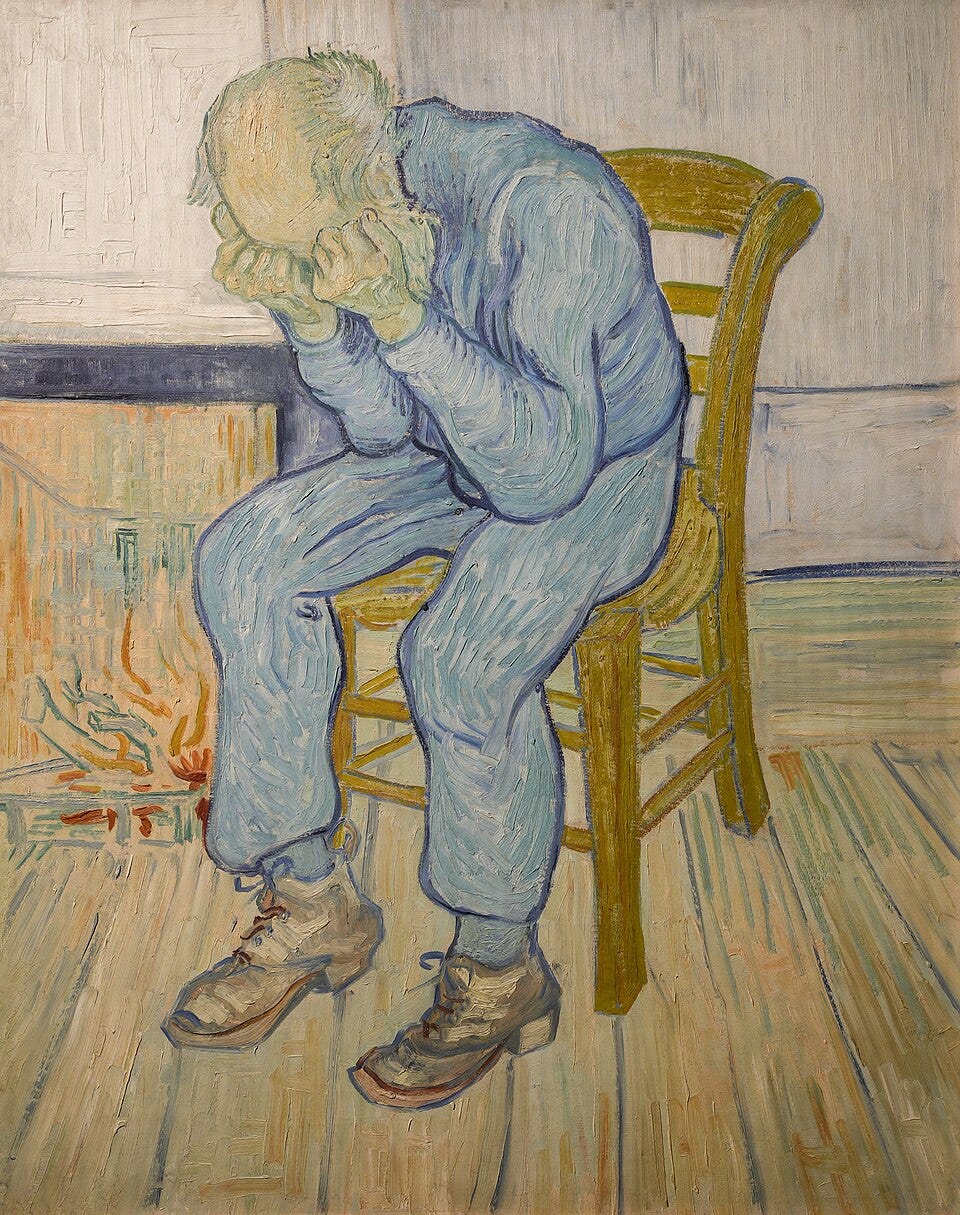
“Old age hath yet his honour and his toil.”
— Alfred, Lord Tennyson, "Ulysses"
There is a certain weight to words spoken by our elders, especially within traditions we hold dear; their perspectives, honed by years of experience, often carry the force of settled wisdom. I was at a Masonic function recently and I overheard a sentiment that has been turning over in my mind ever since; an older brother, with the kind of casual finality that age can sometimes bring, said, "I'm old, so I don't care." He said it with a smile, a jest perhaps to deflect a more serious point of discussion, but the phrase lingered. It struck me with a deep sense of melancholy. It is a phrase I have heard before, in different settings, from men I respect; and each time, it feels like a quiet closing of a door that I, at thirty four, am still trying to learn how to open. It speaks to a weariness that seems to go beyond the aches and pains of the body; it suggests a surrender of the spirit. This is an attempt to understand that sentiment, to place it in conversation with the philosophical traditions that have guided my own search for a life well lived.
This casual dismissal of care stands as a statement with deep philosophical implications; it compels an inquiry into the very purpose, the telos, of a human life. The question of whether our existence is a journey with a destination, a work to be completed, or a thing whose meaning simply exhausts itself with the passing of youth and vitality becomes unavoidable. To wrestle with this, we find ourselves turning to the classical world, engaging with the minds who saw a human life as a complete arc and an intelligible whole. They perceived the final chapter as the culmination of all that came before; a time with its own unique challenges, virtues, and duties.
Plato, in the opening of his Republic, introduces us to Cephalus, an elderly and respected man. When Socrates asks him about the experience of old age, Cephalus offers a surprising perspective: he speaks of it as a liberation. He finds that as the desires of the body recede, the love of reason and discourse grows stronger. He reports that "for old age brings us profound repose and freedom from this sort of thing. When the appetites have ceased to importune us and have come to rest, we are freed from many and mad masters." This Platonic vision presents our later years as a clearing, a time when the noise of the world begins to fade, allowing the soul to finally hear itself think. The purpose of a philosophical life is the pursuit of eudaimonia, that rich Greek term for human flourishing which signifies a life of virtue and excellence. Cephalus suggests that old age, by freeing us from certain kinds of turmoil, provides a unique opportunity to cultivate this inner flourishing. To "not care" would be to squander this precious freedom; it would be to find oneself in a quiet room and choose to hear nothing.
This is a high and noble standard, a vision of old age as the philosopher’s ideal season. It presents a life where the soul's ascent continues, perhaps even quickens, as the body's race slows. It is a beautiful thought, and a powerful one. A life lived among others, however, in a world of physical limitations, demands we ask if this noble vision is a universal promise or a rare grace. The reality for many is that a long life brings not just repose but also bitterness; it brings the accumulated weight of disappointments and the undeniable fact of the body's slow betrayal. What becomes of virtue when the mind is clouded by pain or the heart is heavy with loss? What does it look like on the ground? For this, we can turn to Plato’s most brilliant student, who always kept one foot firmly planted in the soil of observable human nature.
Aristotle, ever the pragmatist, offers a more balanced, and perhaps more realistic, view. In his Rhetoric, he paints a portrait of the old as having been "humbled by life." Having seen much and been disappointed often, they can become cynical, overly cautious, and more concerned with what is useful than what is noble. He observes that "they are small-minded, because they have been humbled by life... They are cynical; that is, they tend to put the worse construction on everything." While this might sound like a philosophical justification for apathy, it is important to remember that for Aristotle, virtue is always a mean between two extremes. The rash idealism of youth is one extreme; the cynical detachment of old age is the other. The challenge of a good life is to find the right balance, to cultivate a character that is neither foolhardy nor timid, neither naive nor distrustful. An elder who ceases to care has, in the Aristotelian sense, fallen into a defect of character. They have allowed the weight of their years to extinguish the noble fire that should animate a virtuous soul; their experience, which should be a source of wisdom for the community, curdles into a private indifference.
Aristotle’s analysis leaves us with a critical, and uncomfortable, question. If our character is so intimately tied to the condition of our bodies; if the cooling of our blood leads to a cooling of our courage and spirit; then is the soul's virtue simply a byproduct of a healthy organism? Does the spirit inevitably wither with the flesh? This is a stark challenge to the Platonic ideal of the soul's independent journey. The later Platonists, looking back to their master, offered an answer by fundamentally reorienting the entire perspective. They saw the soul’s journey as the primary drama, with the body’s story being a secondary, and ultimately less significant, plotline.
The later Platonists, like Plotinus and Proclus, saw our entire existence as a grand drama of the soul's journey. The soul descends into the material world, taking on a body as a temporary vessel. Its task, throughout its life, is to purify itself through the practice of the virtues, so that it might ascend back to its divine source. This is a lifelong labor, a continuous process of refinement. Proclus, for example, speaks of a scale of virtues through which the soul ascends: from the natural and ethical virtues of a good citizen, to the purifying virtues that cleanse the soul, and finally to the intellectual virtues that unite it with the divine. From this perspective, old age is the final act. It is the time when the soul, having been tested and tempered by the world, should be at its most luminous. To declare that one "doesn't care" in old age is to lay down the tools of virtue just before the work is complete. It is a tragedy in the truest sense: a story of a great potential left unfulfilled.
As our society ages, this sentiment of disengagement takes on a larger, more troubling dimension. What becomes of a community when its elders, the living repositories of its history and experience, cease to care? The classical model, particularly in Plato, saw the elders as the natural guardians of the state, their wisdom a necessary ballast against the passions of the young. A society whose elders abdicate this role is a society adrift; it loses its connection to its own past and its moral compass for the future. The wisdom of a lifetime, which should be a common treasury, becomes a private possession, locked away and ultimately lost. The intergenerational bonds that create a healthy and cohesive society fray and break. We are left with a collection of individuals, each concerned only with their own season of life, and the great, continuous project of civilization falters. The personal tragedy of a soul that gives up on its own flourishing becomes a collective one: a society that loses the active virtue of its elders loses a part of its own soul.
The consequences for society are, therefore, a magnification of the consequences for the soul. The loss of a guiding wisdom in the state mirrors the loss of a ruling reason in the individual. And it is this parallel that brings the weight of the issue back from the political sphere to the personal. We are not just discussing the health of the republic; we are discussing the health of our own souls and the souls of those we love. The question is not abstract; it is immediate and personal. It asks what we owe to our own character, to our own potential for flourishing, even when the world no longer seems to demand it of us and the body grows tired of the effort.
I understand the weariness. I see it in the faces of my own elders, and I feel the stirrings of it in my own soul after a long week. Life can be a heavy burden to carry. And yet, the philosophical path is one of endurance. It teaches us that our duty to ourselves, and to each other, does not have an expiration date. The care we owe to the world, and to the cultivation of our own character, is a sacred trust that we carry to our last breath. To my elder brothers, I would say this, with all the humility of one who has not yet walked so far down the road: your care is still needed. Your wisdom is a beacon. And your continued presence in the great work of building a better world, and better selves, is a gift to us all.
I'm glad you included that last part to let the elders know they are needed and wanted. Too often I think they hear the younger generations complaining about them and the things they have done. There seems to be an undercurrent of thought that the newest generations "knows better", that they should be the one running things. No wonder the elders have the feeling of not caring anymore.
Reading this post, I had in the back of my head a song playing by Phil Collins, called "I don't care anymore" (also remade by a band called Hellyeah). Another great article brother! But, there is also a flip side. Two things that are the best to let go of; hope and concern. By not caring, it unbinds concern of others judgment or sometimes toxic opinions. This can allow a freedom of external validation with the confidence of prioritizing our own choices; being our authentic self. By 'not caring,' others can accept a person as they truly are (or not) without any false appeal to appease or align our words or behavior to fit in with a group egregore. This may be the point or reason of the elders quiet leason he is sharing?