
The Divine Thomas Taylor
The English Pagan and the Recovery of the Ancient Theology

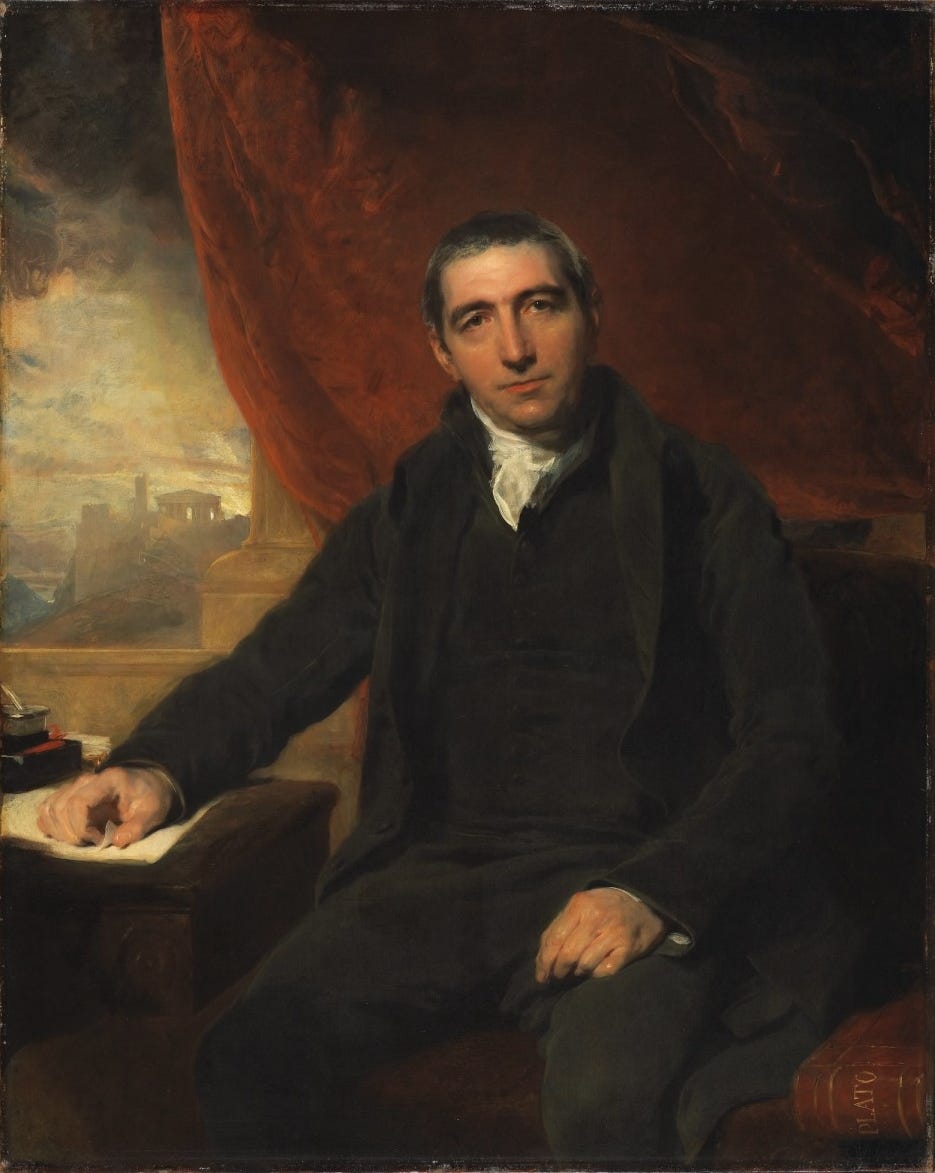
I have been working on this biography, intermittently, for close to a year. Thomas Taylor (1758–1835), known to history as “the English Pagan” and “the Platonist,” was the self-taught London scholar who became the first person to translate the complete works of both Plato and Aristotle into English, along with the greater part of the surviving Neoplatonic corpus, producing over sixty volumes of philosophical translation and original commentary across five decades. He accomplished this without a university education, without institutional support, and in the face of an intellectual establishment that regarded his philosophical commitments as somewhere between absurd and dangerous. He was an avowed pagan and unabashed polytheist in an England dominated by commercial Protestantism, a man who erected altars to the Hellenic gods in his South London home and spoke classical Greek with his wife. He was mocked, marginalized, and largely forgotten by the time of his death; he was also one of the most consequential figures in the transmission of ancient philosophy to the modern English-speaking world. His translations shaped William Blake, Percy Bysshe Shelley, Samuel Taylor Coleridge, Ralph Waldo Emerson, W.B. Yeats, Helena Blavatsky, and the entire trajectory of Western esotericism from the Romantic period to the present day.
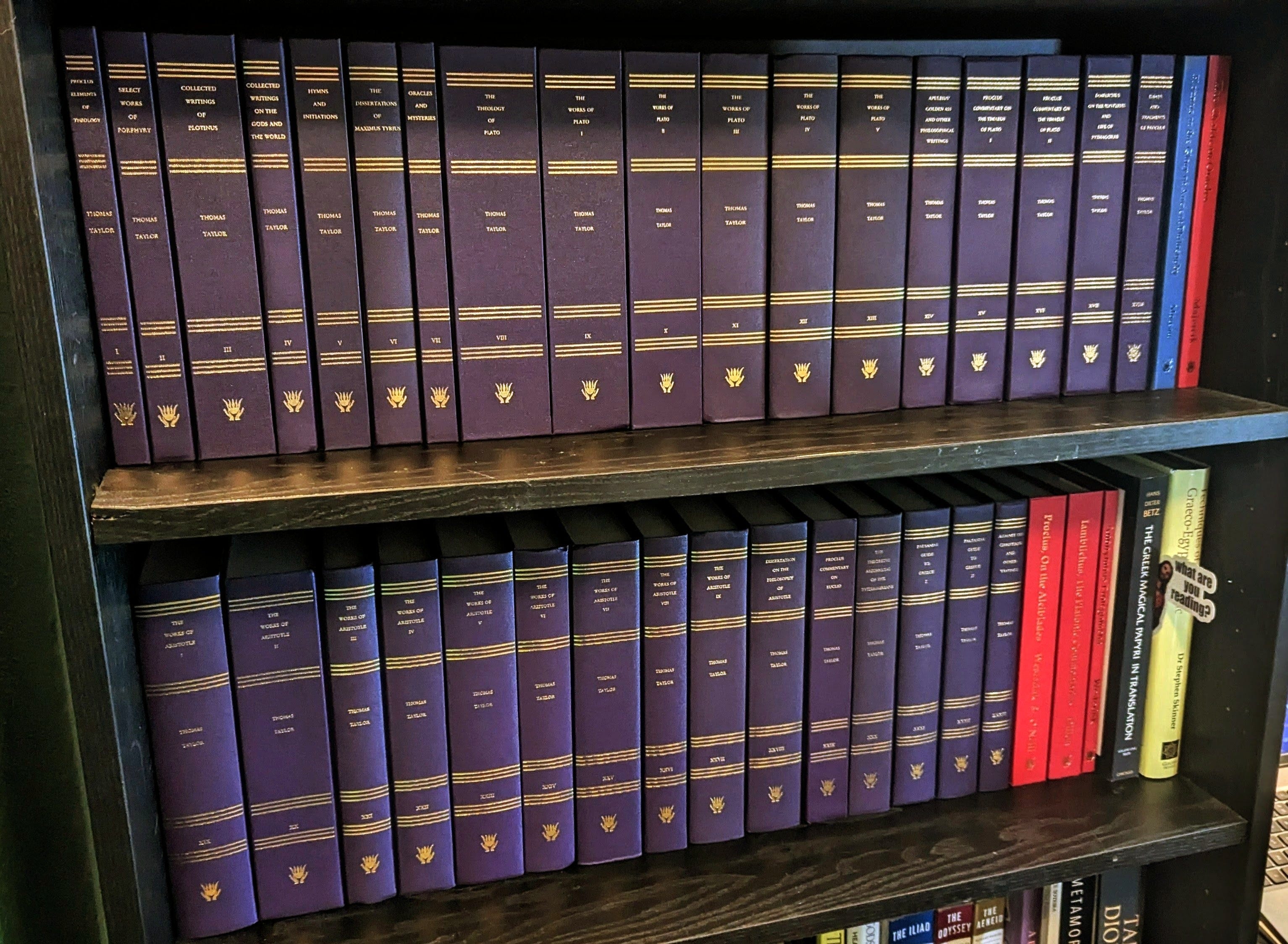
I came to Taylor through his translations, which I own in their entirety courtesy of the Prometheus Trust’s thirty-three volume series (https://kindredstarbooks.com/products/the-complete-thomas-taylor-series). His English is archaic, his sentences sometimes labyrinthine, and his opinions occasionally severe beyond what I would endorse myself. But I have found his works spiritually nourishing in a way that little else in the modern world manages to be. There is something in Taylor’s voice, even filtered through two centuries of distance, that speaks to the part of the soul that remembers where it came from.
I am not an academic. I have an education up to the graduate level, I am a veteran, a father, a Freemason, and a man who tries to take philosophy seriously as a way of life rather than a professional credential. I can relate to Taylor’s life in ways that surprise me: the self-directed study, the conviction that the ancients understood something the modern world has forgotten, the stubborn insistence on pursuing wisdom in conditions that do not reward it. I do not agree with everything Taylor wrote. His anti-Christian polemic is often harsher than I think the situation required, and his dismissal of modernity wholesale leaves no room for the genuine goods the modern world has produced. But I agree with much of it, and I admire nearly all of it, because it was written by a man who meant every word and who sacrificed comfort, reputation, and ease for the sake of the tradition he loved.
All I hope to do with this essay is share some information on a fascinating man and to give him the respect he, and his work, deserves. What follows traces who Taylor was, where he came from, what he believed, what he produced, why it mattered, and how his work survived the hostility of his own era to become the hidden foundation of traditions still alive today. I consider myself a Platonist; and so, with this, I hope the divine smile upon my labors.
Life
On November 1, 1835, a frail old man lay dying of a disease of the bladder in a small house at 9 Manor Place, Walworth, in the sprawl of South London. Some days before the end, he asked those at his bedside whether a comet had appeared. When told that one had, he said: “Then I shall die; I was born with it and shall die with it.” He bore his final suffering with what witnesses described as stoical resignation. He was buried on November 6 at St. Mary’s, Newington Butts. Within a few decades, the graveyard had been converted into a recreation ground, and as Notes and Queries reported, no stone marked the spot; the resting place of the Platonist was unknown. The academic establishment of England, which had dedicated considerable ink to mocking him during his lifetime, barely noted his passing. The Gentleman’s Magazine printed a short obituary. The Athenaeum gave him a few lines. And then the world moved on, deeper into the age of steam and commerce and utilitarian arithmetic that Thomas Taylor had spent his entire life opposing.
The man who died in that modest Walworth house had accomplished something no one before him had done, and no one since has repeated. The great German scholar B.G. Niebuhr, upon learning of the conditions under which Taylor worked, thanked God that he had not been born a poor scholar in England. G.R.S. Mead, secretary to Helena Blavatsky and one of the most serious students of ancient religion in the late nineteenth century, delivered what remains the definitive verdict on Taylor’s achievement: “Though they may know more Greek, he knew more Plato.” Ralph Waldo Emerson called him “a better man of imagination, a better poet, than any other writer between Milton and Wordsworth.” These judgments, each from a figure with no reason to flatter a dead man, point to a reality that the professional academic world of Taylor’s own era could not or would not see: that this impoverished, self-taught translator understood the philosophical substance of the Platonic tradition with an intimacy that formal Greek scholarship alone could not produce.
Thomas Taylor was born on May 15, 1758, in the City of London, the son of Joseph Taylor, a staymaker (a maker of corsets), and Mary Taylor, née Summers. Some early and less reliable sources describe Joseph as a Nonconformist minister of limited income, but W.E.A. Axon’s 1890 biography and the Dictionary of National Biography confirm the humbler trade. The family was of modest, artisan-class means, and their poverty would shadow Taylor for the rest of his life. It is a detail that Taylor himself would have savored, a coincidence carrying the flavor of the ancient doctrine of cosmic sympathy he later championed, that his birthday fell on the seventh of Thargelion in the ancient Athenian calendar: the traditional birthday of Plato. Halley’s Comet was visible in the skies in the months surrounding his birth, and returned again at his death seventy seven years later, a cosmic coincidence he and his admirers cherished as a sign of sympathy between his life and the heavens.
His childhood was marked by the fragility of his body and the intensity of his mind. Early signs of what was believed to be tuberculosis forced his parents to send him from London’s soot to the Staffordshire countryside for recuperation. He survived the affliction, but his constitution remained delicate and sickly throughout his life, a physical frailty that stood in sharp contrast to his intellectual stamina. By the age of nine, his precocity earned him a place at St. Paul’s School, one of London’s oldest and most respected institutions. He advanced rapidly, moving through six academic forms in less than three years. But Taylor grew to despise the school’s methods. The eighteenth-century English grammar school focused on the rote memorization of classical languages, treating Greek and Latin as exercises in declension and syntax; the metaphysical substance of the texts, the philosophical spirit that animated them, was entirely ignored. Kathleen Raine noted that even as a schoolboy, Taylor “was already noted for his interest in the philosophic aspect of the classics.” For a boy whose soul strained toward the ideas behind the words, the pedagogical methods were unbearable. He eventually implored his father to remove him from the institution.
What followed was a period of wandering and false starts. Joseph Taylor wanted his son to enter the Nonconformist ministry. There was first a brief and wretched stint learning the trade of a dockyard officer at Sheerness, beginning around 1773, where Thomas endured what he described as three years of slavery. The Shrine of Wisdom magazine, writing in 1925, preserved the detail that during this period the young Taylor kept a tinder-box under his pillow so he could light candles at night to study while his father slept. After returning from Sheerness around 1776, he spent roughly two years studying under a Reverend Mr. Worthington of Salters’ Hall meeting-house, preparing for the Dissenting ministry. It was during this period of theological training that he applied himself seriously to Greek and Latin, mastering the languages that would become the instruments of his life’s work. But the ministry was not to be his path.
Taylor had fallen in love with Mary Morton, his childhood sweetheart. When he learned that her father intended to force her into an arranged marriage with a wealthier man, the young couple orchestrated a secret, defiant union. Mary agreed to a purely formal marriage on condition that it remain undisclosed until Taylor finished his studies. When her mother discovered the secret, both families abandoned the young couple. Taylor’s prospects for the ministry were obliterated. His family’s support was withdrawn. Any hope of attending university vanished. For nearly a year, they survived on seven shillings a week, with Taylor working as an usher, a teaching assistant, at a school in Paddington. The marriage had cost him everything that Georgian respectability valued; it had also freed him, though he did not yet know it, for the work that would define his life.
Around 1780, he secured a clerkship at Lubbock’s Bank in London at fifty pounds per year, paid quarterly. He rented the small house at 9 Manor Place, Walworth, where he would live for the rest of his life. The six years at the bank were a kind of purgatory. His biographers record that he was often unable to procure enough nourishment during the day, and that by evening he was sometimes so exhausted that he fell senseless on the floor upon reaching home. He made it a rule, while walking about the City with bills and ledgers, to silently digest what he had learned from Aristotle. And by night, when the city quieted, he studied Greek philosophy in hours stolen from sleep, reading by candlelight until two or three in the morning before rising again for the bank. His first publication appeared in 1780: The Elements of a New Method of Reasoning in Geometry, Applied to the Rectification of the Circle, a work hinting at the Pythagorean mysticism in mathematics that would become one of his lifelong preoccupations.
The intellectual development that took place during these years followed what the Dictionary of National Biography calls “the usual order of study inverted.” Taylor did not learn Greek through grammar primers and easy texts; he taught himself the language through Plato, beginning with the most demanding philosophical prose the tongue had ever produced. His progression ran from mathematics to Aristotle to Plato, and then to the encounter that changed everything. When Taylor first read Plotinus, the third-century philosopher who had systematized the mystical dimensions of Platonic thought into a comprehensive metaphysics of emanation and return, something like a conversion occurred. He read Plotinus, as he recorded in Public Characters of 1798, “with the most rapturous delight.” From Plotinus he went to Proclus, the fifth-century Athenian philosopher who had synthesized the entire Platonic tradition into its most elaborate and systematic form. Taylor read Proclus’ voluminous works three times, a feat that Fraser’s Magazine observed in 1875 had “probably been performed by no other mortal since the Renaissance.” Proclus and Iamblichus, the fourth-century Syrian philosopher who had defended the practice of theurgy (ritual communion with the divine) as the necessary complement to philosophical contemplation, became Taylor’s supreme guides. He never looked back. His library, when sold at auction after his death, contained only manuscripts and books in Greek, Latin, and English; he had no reading knowledge of German or French, a fact with significant implications for his isolation from contemporary Continental Neoplatonic scholarship.
The event that transformed Taylor from an obscure bank clerk studying philosophy at night into England’s foremost expositor of Plato was, paradoxically, a spectacular public failure. While scouring ancient texts, Taylor had become fascinated by accounts of perpetual lamps, mysterious unquenchable lights reportedly found still burning in sealed subterranean tombs centuries after their creation. Convinced that the ancients possessed a physical, perhaps alchemical science that the moderns had lost, he engineered a device using a volatile mixture of oil, salt, and immersed phosphorus. In late 1784, he arranged a public demonstration of his perpetual lamp at the Freemasons’ Tavern in London. The intense heat generated by the chemical reaction caused the device to explode, setting the room on fire and sending attendees into a panic. His hopes of profiting from the invention were permanently extinguished.
But the spectacle attracted attention. Taylor’s brilliance and encyclopedic knowledge of Greek philosophy, evident to anyone who spoke with him, impressed several influential figures in the audience. Among them was the sculptor John Flaxman, whom Kathleen Raine described as “one of the moving spirits at the very heart of the Greek revival in the visual arts.” Around 1785 to 1787, Taylor delivered twelve lectures on Platonic philosophy at Flaxman’s house. The audience included Sir William Fordyce, the Honourable Mrs. Damer, and the painter George Romney, drawn from London’s artistic and intellectual elite. These lectures, never published, established Taylor’s reputation and widened his circle. George Cumberland, an early friend, helped him leave banking. The brothers George and William Meredith, men of modest wealth but genuine literary taste, became his most consistent patrons; William Meredith eventually provided an annuity that enabled Taylor to devote himself full-time to translation. Taylor named his daughter Mary Meredith Taylor in gratitude. Henry Charles Howard, the thirteenth Duke of Norfolk, subscribed for the entire impression of the five-volume Plato, a magnificent act of patronage whose practical effect was limited by the Duke’s decision to lock most copies in his own library, severely restricting circulation.
In 1787, the two works that launched Taylor’s philosophical career appeared: The Mystical Initiations; or, Hymns of Orpheus, the first English translation of the Orphic Hymns, and Concerning the Beautiful, a translation of Plotinus’ Ennead I.6, the first rendering of any Plotinus into English. These were followed in 1788 and 1789 by his translation of The Philosophical and Mathematical Commentaries of Proclus on the First Book of Euclid’s Elements, a work that included his landmark essay, “A History of the Restoration of the Platonic Theology by the Later Platonists,” in which Taylor laid out the lineage of what he called the golden chain of philosophers stretching from Orpheus and Pythagoras through Plato to the late Neoplatonists. The publication drew the attention of the Marquis de Valadi, a young French neo-Pythagorean nobleman who crossed Europe expressly to study with Taylor and stayed in his humble Walworth home during the winter of 1788 to 1789. Valadi’s surviving letter captures the intensity of the encounter: “O Thomas Taylor! A divine man! A prodigy in this iron age!” The Marquis returned to France and was guillotined during the Reign of Terror at the age of twenty-seven. Around 1789, Taylor also published, anonymously and with a false Amsterdam imprint, A New System of Religion, openly advocating pagan polytheism. Reviews dismissed it as the work of a madman, though the Prometheus Trust’s Tim Addey has argued that the attribution to Taylor may be incorrect.
Thought
Taylor understood Platonism as a perennial, living philosophical tradition. He refused to use the term “Neoplatonism,” which had been coined by German historians in the 1770s and 1780s as a pejorative, and spoke indiscriminately of “Platonism” and “Platonists” even when referring to figures like Proclus or Damascius, insisting on the unbroken continuity of doctrine from Orpheus through the last heads of the Athenian Academy. His General Introduction to the Works of Plato, published in 1804, opens with the definition of Hierocles: “Philosophy is the purification and perfection of human life.” Taylor described philosophy as “a luminous pyramid, terminating in Deity, and having for its basis the rational soul of man,” and called Plato “the primary leader and hierophant” of this philosophy, “through whom, like the mystic light in the inmost recesses of some sacred temple, it first shone forth with occult and venerable splendour.”
His canonical enumeration of the golden chain reads: “The most conspicuous of these are, the great Plotinus, the most learned Porphyry, the divine Iamblichus, the most acute Syrianus, Proclus the consummation of philosophic excellence, the magnificent Hierocles, the concisely elegant Sallust, and the most inquisitive Damascius.” Each epithet is precisely chosen and reveals Taylor’s hierarchy of esteem. Plotinus was transformative; Taylor praised his “sublime and godlike soul.” Porphyry he called the most learned, but following Iamblichus he judged Porphyry deficient in theological understanding. Iamblichus received the supreme epithet, “the most divine,” and Taylor’s introduction to On the Mysteries in 1821 stands as one of his most important original writings, framing the work as “the most copious, the clearest, and the most satisfactory defence extant of genuine ancient theology.” Proclus was his supreme philosophical guide: the man whose works he read three times, after whom he named a son Thomas Proclus Taylor, and whom he considered the consummation of philosophic excellence. The Theology of Plato, which Taylor translated in 1816 in two volumes, was what he regarded as the crowning glory of the entire Platonic tradition.
The metaphysics Taylor drew from these sources follows the Proclean structure of emanation with precision. From his Platonic Philosopher’s Creed, first published in 1805: “There is one first cause of all things, whose nature is so immensely transcendent, that it is even superessential; and that in consequence of this it cannot properly either be named or spoken of, or conceived by opinion, or be known, or perceived by any being.” The One, the first principle, is beyond being itself. The appellations “the One” and “the Good” are, Taylor wrote, “of all others the most adapted to it,” the former indicating it as the principle of all things, the latter that it is the ultimate object of desire to all things. The most proper veneration of this first cause is to “extend in silence the ineffable parturitions of the soul to its ineffable co-sensation,” approaching it as a “thrice unknown darkness, the God of all Gods.”
From this ineffable One proceeds, prior to everything else, a multitude of natures characterized by unity: the gods, the henads (divine unities), each leading a series that extends from itself to the last of things. Taylor was a genuine polytheist, but his polytheism was philosophically rigorous. As the scholar Thomas Yaeger has observed, what is radical about both Taylor and Iamblichus is the suggestion that ancient polytheism is actually a product of a form of monotheism built on philosophical argument. Taylor explicitly denied the euhemeristic position that the gods were deified mortals: “the deification of dead men, and the worshipping men as Gods form no part of this theology when it is considered according to its genuine purity.” The gods were real, intermediary intelligences, emanations from the One that mediated between the transcendent source and the material world. Below the gods stood the hierarchy of intellect, or nous, the realm of Platonic forms and eternal ideas; then psyche (soul), the mediator animating the sensible world; and finally matter, a passive substrate at the limit of emanation. Evil, following Proclus, was not a positive principle but a privation; matter is entirely passive and cannot originate anything.
The human soul, for Taylor, descends from the intelligible world into material embodiment and must return through purification. Point 18 of the Platonic Philosopher’s Creed states: “Man is a microcosm, comprehending in himself partially every thing which the world contains divinely and totally.” The soul can only be restored while on earth to the divine likeness it abandoned by its descent through the exercise of the cathartic and theoretic virtues, the former purifying it from the defilements of a mortal nature, the latter elevating it to the vision of true being. This process of return, epistrophe in Greek, was the purpose of philosophy; and Taylor believed in metempsychosis (the transmigration of souls), holding that souls could enter brutish bodies if degraded. As Hierocles had taught, the Platonic aim was the purification and perfection of human life, whereby virtue exterminates the immoderation of the passions and truth introduces the divine form into receptive souls.
Taylor’s engagement with theurgy was central to his philosophical identity, and it separated him from the tradition of Christian Neoplatonism that Ficino had established during the Italian Renaissance. He understood theurgy as the practical, ritual dimension of Platonic philosophy; the ancient mystery religions and their rites were, in his reading, the practical enactment of philosophical truths. From Point 14 of the Platonic Philosopher’s Creed: “The honours which are paid to the Gods are performed for the sake of the advantage of those who pay them... temples imitate the heavens, but altars the earth. Statues resemble life... From all these, however, nothing happens to the Gods beyond what they already possess; but a conjunction of our souls with the Gods is by these means effected.” This is a position drawn directly from Iamblichus and Proclus: ritual and sacrifice do not change the gods but attune the human soul to receive divine illumination. Taylor’s Dissertation on the Eleusinian and Bacchic Mysteries, first published in 1790, argued that the Orphic Hymns were the invocations used in the Eleusinian Mysteries, and that the rites could be interpreted on multiple levels following the Neoplatonic tradition articulated by Sallust: the fable itself; the physical interpretation; the animastic level, in which Proserpina’s descent represents the descent of the soul; and the theological-metaphysical level, pointing toward the One. Kathleen Raine argued that Taylor’s greatest service to the Romantic poets was in teaching the use of symbolic discourse as the language of metaphysical thought.
For Taylor, philosophy and religion were inseparable: the theoretical and practical dimensions of one unified tradition. The Chaldean Oracles, the Hermetic writings, the Orphic Hymns, and the Platonic dialogues were all expressions of a single theology. And he was not theorizing from a comfortable distance. He reportedly established a sacrarium, a sacred room, in his Walworth home and offered sacrifices to the ancient gods. His paganism earned him the title “the English Pagan,” and in Georgian England it was a provocation of the first order. He and his wife spoke classical Greek to each other at home. He made libations to the Olympians in his garden. He viewed the Earth as spiritually insignificant, describing it in his writings as “a mere toad or viper, perhaps, in the scale of worlds.” He dreamed of establishing a public Pantheon in London for the worship of the Greek gods; when this proved impossible, he retreated into the domestic sphere and worshipped privately.
His animosity toward orthodox Christianity was fierce and unwavering. As Fraser’s Magazine observed in 1875, his zeal “has more in it of the spirit of loathing and abhorrence, which one may suppose to have animated some disestablished sacerdos of Constantine, than a mild and cultured scholar of the nineteenth century.” Taylor believed that Christianity had established “a tyranny over the human mind utterly unknown to the ancient world,” that it had “extirpated from the earth the dominion of wisdom and virtue, substituting in its place the modern spirit of barter and trade.” It operated as a suppressive force: “Penetrating and smooth, it has crept like oil through the various communities of mankind, suppressing the effervescence of desire, restraining the restless spirit of inquiry, and calming the impetuosity of genius.” He scorned Christian humility, writing that “humiliating conceptions flourish no where but in the breasts of the servile, or the base.” His anti-Christian works included The Arguments of the Emperor Julian against the Christians in 1809 and Arguments of Celsus, Porphyry, and the Emperor Julian, Against the Christians in 1830, as well as polemic laced through the introductions and notes to virtually all his translations. In the Platonic Philosopher’s Creed, Taylor declared himself “not ashamed to own... a perfect convert” to the religion of the heathens as understood by Pythagoras and Plato.
The extent and nature of his domestic worship quickly became the stuff of London legend, distorted and amplified by his enemies. One of the most persistent rumors, attributed to Walter Savage Landor, claimed that Taylor had attempted to sacrifice a live bull to Jupiter in his back parlor, and that the bull whisked its tail in the worshipper’s face and burst through the window. This anecdote is almost certainly a satirical fabrication. Taylor’s paganism was informed by Orphic and Pythagorean ethics, which made literal blood sacrifice philosophically contradictory; he was a strict vegetarian whose translations of Porphyry’s On Abstinence from Animal Food reinforced his conviction in the spiritual kinship of all living beings. His sacrifices within the Walworth sacrarium were, in all probability, bloodless oblations: the burning of specific incenses, libations of wine, and the recitation of the Orphic Hymns he had translated and published in 1787, including the ancient instructions for the proper fumigations (frankincense, myrrh, storax) required to invoke each deity. A famous tradition holds that during the French Revolution, Taylor donned the robes of an Arch-flamen, an ancient Roman priest, and led a procession of initiates through the streets of the City of London to the Old Exchange, where he performed rites of lustration to spiritually cleanse the city and formally receive it back into the dominion of the king of the gods. The tradition may be legendary; it captures the spirit of the man.
Works
The sheer scale of Taylor’s translation work defies comprehension when measured against the conditions under which it was produced. His ambition was the systematic translation of all the previously untranslated writings of the ancient Greek philosophers into English, and he came closer to fulfilling that ambition than anyone would have thought possible. His methodology was radically different from the philological approaches emerging in the Enlightenment academies. He did not translate Plato as an isolated thinker to be read literally; he translated Plato through the eyes of the Neoplatonists, whom he regarded as the sole true interpreters of Plato’s “mystic speculations,” possessing “a nature similar to their leader” and capable of unfolding the full reach of his conceptions. This was the core of the scholarly controversy that surrounded him during his lifetime and for more than a century after his death.
His magnum opus was the translation of the complete works of Plato, published in five volumes in 1804, comprising all fifty-five dialogues and twelve epistles, the first time the English-speaking world had access to the entirety of Plato in its own language. Taylor supplemented his translations with exhaustive notes drawn from the commentaries of Proclus, Olympiodorus, and Damascius, ensuring that the reader was guided by the Neoplatonic hermeneutic he believed to be authoritative. The General Introduction to the Philosophy and Writings of Plato that prefaced these volumes is one of the most sustained and passionate defenses of Platonic philosophy in the English language. He followed the Plato with the complete works of Aristotle, published between 1806 and 1812 in nine volumes, funded by the Meredith brothers. Taylor viewed Aristotle as a necessary precursor to Plato, the mandatory logical and metaphysical preparation for ascending to the theological heights of Platonic thought.
The catalog of his other translations constitutes, by itself, an achievement of immense scope. He produced the first English translations of any Plotinus, beginning with Concerning the Beautiful in 1787 and culminating in the Select Works of Plotinus in 1817. He translated the Orphic Hymns (1787, revised 1824); Proclus’ Commentary on the First Book of Euclid’s Elements (1788–1789); Proclus’ Platonic Theology (1816); Proclus’ Commentary on the Timaeus (1810, second edition 1820); Iamblichus’ On the Mysteries of the Egyptians, Chaldeans, and Assyrians (1821), the first English rendering of the De Mysteriis; Iamblichus’ Life of Pythagoras (1818); the complete Pausanias (1794, the first English translation); Sallust’s On the Gods and the World (1793); Julian’s Orations (1793); Porphyry’s On Abstinence from Animal Food and On the Cave of the Nymphs (1823); Ocellus Lucanus (1782, expanded 1831); Maximus Tyrius (1804); and the Metamorphosis of Apuleius (1822). His original works included the Dissertation on the Eleusinian and Bacchic Mysteries (1790); Theoretic Arithmetic (1816), drawing on Theon of Smyrna, Nicomachus, Iamblichus, and Boethius to present Pythagorean number symbolism as a form of theology; and numerous articles in the Classical Journal between 1817 and 1831 on subjects ranging from the daemon of Socrates to the antiquity of alchemy. He compiled the Chaldean Oracles into English and produced copious introductions, dissertations, and prefaces to every major translation.
The quality of Taylor’s translations has been debated since the day the first one appeared. Coleridge quipped that Taylor’s Proclus was “so translated that difficult Greek is translated into incomprehensible English.” Richard Porson, the supreme textual critic of the age, born within months of Taylor, made philological attacks on his renderings. W.B. Yeats, who admired Taylor’s philosophical content, called his style “atrocious.” The persistent charges were archaic and verbose prose, reliance on Latin intermediaries (particularly Ficino’s translations) alongside Greek, and, above all, Neoplatonic bias: the reading of Plato through the lens of Proclus. The Edinburgh Review and other journals dismissed his work with contempt. James Mill, the utilitarian philosopher and father of John Stuart Mill, writing anonymously in the Literary Journal in 1804 and the Edinburgh Review in 1809, launched the most devastating attacks. Mill drew heavily on the biased historiography of Jacob Brucker’s Historia critica philosophiae (1742–1744), which condemned Neoplatonism as corrupt, syncretic, and infected by Eastern superstition. Mill accused Taylor of being “guilty by association” for utilizing Neoplatonist commentators to explain Plato, charging him with burying the philosopher in “impenetrable darkness” and the “thick smoke” of his esoteric vocabulary. Blackwood’s Edinburgh Magazine went so far as to call him an “ass” and a “fool,” dismissing him with the claim that “he knows next to nothing of the language about which he is always writing,” a charge that modern scholars, noting that Taylor was specifically commissioned to produce a new edition of Hedericus’s Greek Lexicon in 1803, find baseless.
There is another side to the ledger. Taylor was self-trained, and he lacked the polished facility that a university education might have brought. But modern scholars acknowledge his consistency: having one translator kept Greek terms uniformly rendered across a body of work that spanned the entire classical philosophical tradition. And there is the matter of his emendations. When Taylor’s copies of Proclus’ Theology of Plato lacked certain lines due to manuscript damage, he filled them in based on his philosophical understanding of what the argument required. Years later, when fuller manuscripts were discovered, his conjectural restorations proved remarkably accurate. This was the work of a man who understood his texts so intimately that he could reconstruct their logic from the inside. Where the English classical establishment, represented by Porson, pursued words, Taylor pursued meaning. Where they valued grammatical precision, he valued philosophical depth. No complete alternatives to his translations existed until the twentieth century, and Neoplatonist scholarship still consults Taylor’s glosses. The dominant mode of classical scholarship in Taylor’s England was textual criticism, the philological labor of freeing ancient texts from manuscript corruption. Taylor’s approach was antithetical to this ethos, and his marginalization was inevitable. As Frank B. Evans wrote in his landmark 1940 article, Taylor was “the most energetic exponent of Platonism in England between the Cambridge Platonists and Benjamin Jowett.”
Taylor’s unique contribution can be understood in relation to his most obvious predecessor, Marsilio Ficino, who had undertaken the same monumental task of translating the Platonic corpus into a new language for the first time during the Italian Renaissance. Leo Catana’s 2011 study demonstrated that Taylor was no epigone of Ficino; the differences are fundamental. Ficino operated within a Christian Neoplatonic tradition, stating that “Dionysios the Areopagite is the height of Platonic doctrine, and the pillar of Christian theology.” Taylor favored the Hellenic, non-Christian Neoplatonists who were either neutral toward or hostile to Christianity. He did not mention Pseudo-Dionysius, Marius Victorinus, or Augustine in his General Introduction to Plato. In 1804, he wrote explicitly that Ficino, Pico, and Henry More, “in order to combine Christianity with the doctrines of Plato, rejected some of his most important tenets, and perverted others, and thus corrupted one of these systems, and afforded no real benefit to the other.” Taylor saw himself as recovering a pure, pre-Christian Platonism, treading a path that had not been walked since the Emperor Justinian closed the Athenian Academy in 529 CE. Ficino had the Medici fortune and the resources of the Florentine state at his disposal. Taylor worked in poverty, supported by private patrons of modest means.
One of the most fascinating texts in Taylor’s corpus is the small, anonymous pamphlet he published in 1792: A Vindication of the Rights of Brutes. Thomas Paine had published The Rights of Man in 1791, and Mary Wollstonecraft, who had earlier found an “abode of peace” in Taylor’s home when she lodged with him around 1787 to 1788, published her Vindication of the Rights of Woman the following year. Taylor, whose Neoplatonic worldview was hierarchical and emanationist, found the egalitarian arguments of the Enlightenment philosophically absurd. Seeking to destroy the logic of universal rights through a reductio ad absurdum, he argued that if perfect equality was granted to all men and women, there was no philosophical barrier to extending it to animals and plants. By constructing what he believed to be a farcical case for the “perfect equality of what is called the irrational species to the human,” he intended to collapse the entire framework under the weight of its own extreme.
The text reveals a paradox that makes it a unique artifact in intellectual history. Taylor was a devout Platonist who believed in the transmigration of souls and the sacred kinship of all life, a strict vegetarian who held that animals possessed souls. When tasked with writing a satirical defense of animal rights, he drew upon the genuine arguments of philosophers like Porphyry. The resulting text, though framed as a conservative joke, articulated sophisticated biocentric arguments: animals were entitled to moral consideration because of their intrinsic capacities for reason, communication, and emotion. The historian Peder Anker has called it the first defense of animal rights. Thomas Taylor, attempting to destroy the modern concept of universal rights, inadvertently produced one of the foundational documents of the movement he was satirizing.
Reception
Taylor’s connections to the great figures of his age are extensive. William Blake, born six months before Taylor in November 1757, shared intellectual circles with him through Flaxman. Blake almost certainly attended Taylor’s lectures at Flaxman’s house. A famous anecdote, recalled by William Meredith the younger in 1829, records that Taylor gave Blake lessons in mathematics and reached the fifth proposition of Euclid, at which point Blake interrupted: “Ah, never mind that; what’s the use of going to prove it? Why, I see with my eyes that it is so, and do not require any proof to make it clearer.” Blake’s own copy of Taylor’s Mystical Initiations was discovered in 2001 at the Bodleian Library with what appears to be marginalia in Blake’s hand. George Mills Harper’s The Neoplatonism of William Blake (1961) traced the connection thoroughly; F.E. Pierce identified approximately fifty parallels of thought and imagery between the two men’s works.
Percy Bysshe Shelley maintained several of Taylor’s translations on his shelves at Oxford and explicitly requested that Taylor’s translation of Pausanias be obtained and sent to him. J.A. Notopoulos documented Taylor’s influence on Shelley in a study published in PMLA in 1936. Shelley was reputedly part of a loosely defined Orphic circle of Romantic writers who, inspired by Taylor’s Hymns of Orpheus, engaged in honoring the Greek gods with hymns and ritual. Samuel Taylor Coleridge, who described himself as a student of “all the strange phantasms that ever possessed your philosophy-dreamers from Tauth [Thoth], the Egyptian to Taylor, the English Pagan,” publicly criticized Taylor as a blind bigot while privately drawing upon Neoplatonic concepts of light, emanation, and polarity in constructing his theories of the poetic imagination. F.E. Pierce documented parallels between Wordsworth and Taylor in Philological Quarterly in 1928. As Raine argued, for the Romantics who could not read Greek, Taylor’s translations were the texts, his interpretations the guide. The texts he placed in the hands of the Romantic poets were the same that Ficino had made accessible to Botticelli, Raphael, and Michelangelo.
Raine’s thesis, now the standard scholarly view, holds that Taylor was the channel through which Neoplatonic ideas reached the English Romantics at a moment when those ideas were urgently needed. Neoplatonism and Romantic aesthetics shared fundamental commitments: the primacy of imagination over sensory experience, the conviction that visible nature manifests invisible spiritual realities, the belief in a living, ensouled cosmos against the dead mechanism of Enlightenment science. Taylor provided the philosophical resources for those commitments. Raine’s metaphor has become well known: Neoplatonism is “an underground river that flows through European history, sending up, from time to time, springs and fountains; and wherever its fertilizing stream emerges, there imaginative thought revives, and we have a period of great art and poetry.” Taylor was the principal spring of that river in the English-speaking world.
The geographic pattern of Taylor’s reception contains its own irony. While he was mocked by the utilitarian reviewers of Edinburgh and London, his work was received on the opposite side of the Atlantic with something approaching reverence. The American Transcendentalists, searching for an intellectual framework that transcended both the sterile doctrines of Calvinism and the rigid empiricism of John Locke, found their vocabulary in Taylor’s translations. Ralph Waldo Emerson began reading Taylor in 1826, and the scholar Richard Geldard has argued that “it was the Taylor influence during the period 1826 to 1848 that shaped Emerson’s vision more than any other,” surpassing Kant and Goethe. Geldard called Taylor “Emerson’s John the Baptist, crying out in the wilderness.” Emerson wrote that “a reading of Iamblichus’ On the Mysteries would bring about a revival in the Churches” and confessed, “I read Proclus for my opium.” Bronson Alcott traveled to England specifically to collect the complete works of Thomas Taylor and brought them back to New England, distributing them among the intellectual elite. Thomas Moore Johnson, directly inspired by Taylor, founded The Platonist (1881–1888), the first American periodical devoted to Platonic philosophy. Through Thomas Wentworth Higginson, even Emily Dickinson “probably owed her Platonism ultimately to Thomas Taylor.” When Emerson visited England years after Taylor’s death, he expressed astonishment that the translator was unknown in his own country, noting that “every library in America has books by him.”
Taylor’s work also became the bedrock of the late nineteenth-century occult revival. The Orphic Circle, originally a designation for Shelley’s romantic associates, re-emerged in the 1830s and 1840s in London as a network of practicing occultists; figures like Frederick Hockley and Emma Hardinge Britten used the fumigations and translated verses from Taylor’s Orphic Hymns in their magical workings. Helena Blavatsky and the Theosophical Society relied on Taylor’s translations of Iamblichus and Proclus. G.R.S. Mead, Blavatsky’s secretary, edited and reissued several of Taylor’s works, and his interpretation of Orphism was an expansion of Taylor’s preface to the Hymns. Members of the Hermetic Order of the Golden Dawn, including W.B. Yeats, drew on Taylor’s Proclus and Plotinus in constructing their ritual systems. AE, the Irish poet George Russell, called Taylor “the Uncrowned King.” Kathleen Raine’s Blake and Tradition (1969) and her edition of Taylor’s selected writings, published by Princeton in the Bollingen Series, carried the influence into the late twentieth century.
Legacy
Taylor’s social world in London deserves attention in its own right. James Boswell, after reading Taylor’s preface to the Hymns of Orpheus, recorded in his journal that it “fanned my mind to perceive him quite absorbed in the wildness of Ancient Metaphysicks.” Thomas Love Peacock, the novelist, was a lifelong friend. “Walking” John Stewart, the eccentric philosopher-traveller who had wandered through Persia and India, debated with Taylor at London gatherings. The broader circle included the radical publisher Joseph Johnson and the network of Dissenters, artists, and political reformers that orbited Johnson’s shop: William Godwin, Thomas Paine, Joseph Priestley, and Henry Fuseli. Taylor existed within this radical milieu while being philosophically opposed to its premises: too pagan for the Christians, too mystical for the rationalists, too ancient for the radicals. As one commentator observed, a pagan philosopher seemed an anachronism in the London of the nineteenth century of Christianity.
Taylor’s personal life, like his intellectual life, was marked by endurance. His first wife Mary Morton, who had defied her father to marry him in secret and survived the years of seven-shillings-a-week poverty, died in 1809. He remarried; his second wife Susannah died in 1823, aged about thirty. His son Thomas Proclus Taylor was born to Susannah in 1816, the same year Taylor published Proclus’ Theology of Plato and Theoretic Arithmetic. In 1798, he was appointed Assistant Secretary of the Society for the Encouragement of Arts, Manufactures, and Commerce (precursor to the Royal Society of Arts), a position he held until 1806, when he resigned to devote himself entirely to translation. In 1802, he visited Oxford and received a hearty welcome from the dons, used the Bodleian Library, and dined at New College, though he was, characteristically, hardly reconciled to what he called the “monkish gloom” and “barbaric towers and spires.” In 1830, he published his last major polemical work, Arguments of Celsus, Porphyry, and the Emperor Julian, Against the Christians. His final Plotinus translations appeared in 1834, including a rendering of the passage On Suicide, the year before his death.
The intellectual climate against which Taylor labored should be understood with some specificity, because the hostility he faced was not accidental. British philosophy in the late eighteenth and early nineteenth centuries was shaped by Lockean empiricism and Newtonian mechanism. Sensation, reflection, and experiment were the privileged modes of knowing; innate ideas were rejected; transcendent Forms were considered relics of medieval obscurantism. At Oxford and Cambridge, the curriculum centered on Locke’s Essay Concerning Human Understanding, Paley’s natural theology, and Newtonian mathematics. Both universities required subscription to the Thirty-Nine Articles, barring all Dissenters, let alone pagans, from academic positions. The hostility to Taylor’s Neoplatonic Plato had roots in Protestant historiography. Brucker’s Historia critica philosophiae, the most influential history of philosophy in the eighteenth century, condemned Neoplatonism as corrupt and syncretic. This framework was absorbed into English intellectual life through William Enfield’s 1791 translation. When James Mill attacked Taylor, he drew on Brucker, treating Neoplatonic readings as erroneous by definition, transferring the assumed negative qualities of Neoplatonism to Taylor’s own interpretation. Taylor viewed his critics with contempt: men hopelessly occupied with the “enumeration of effects” (empirical science and utilitarian metrics) while abandoning the “doctrine of causes” (metaphysics, theology, and the nature of the soul).
The recovery of Taylor’s reputation began slowly and remains incomplete. The twentieth century brought serious scholarly attention: Frank B. Evans’ articles in PMLA (1940) and Modern Philology (1943), Raine and Harper’s Princeton edition (1969), Leo Catana’s studies in the International Journal of the Platonic Tradition (2011, 2013), and Steven George Critchley’s doctoral thesis at the University of York (2006). The Prometheus Trust began publishing the Thomas Taylor Series in 1994. The series comprises thirty-three hardcover volumes totaling approximately seventeen thousand pages, bound in purple buckram with gold blocking: the complete Plato, the complete Aristotle, Proclus’ Theology of Plato, Commentary on the Timaeus, Commentary on Euclid, and Elements of Theology; Iamblichus’ On the Mysteries and Life of Pythagoras; the collected Plotinus; Porphyry’s Select Works; the Orphic Hymns; the Chaldean Oracles; Pausanias; Apuleius; Maximus Tyrius; and Taylor’s original essays, articles, and polemics. They are available in the United States through Kindred Star Books.
I write about Taylor because his story speaks to questions I find unavoidable. The transmission of wisdom across centuries, the golden chain that links teacher to student across the abyss of time, the duty to preserve and communicate what the ancients called the sacred things: these are the obligations of anyone who has received the light and understands that it was not given for private enjoyment alone. Taylor received Plato and Plotinus and Proclus in the darkness of a bank clerk’s stolen hours, and he spent the rest of his life forging those texts into an English vessel so that others might drink from the same source. He did this at immense personal cost: poverty, ridicule, social exile, the deaths of two wives, and the indifference of an establishment that could not see past his paganism to the substance of his achievement.
The Prometheus Trust’s Tim Addey has written: “For the serious student of philosophy, that is to say those who are pursuing philosophy as a path to enlightenment, the translations and writings of Thomas Taylor cannot be overestimated.” That judgment is correct. Taylor understood something that the professional academic world, with its departmental specializations and tenure anxieties, has largely forgotten: that philosophy, in the original sense of the word, is the love of wisdom, and that wisdom is a transformative power demanding personal commitment rather than detached analysis. He understood that the texts of Plato and Proclus and Iamblichus are living instruments of the soul’s return to its source. He lived this understanding in every dimension of his existence, from the sacrarium in his Walworth home to the Greek he spoke with his wife to the hours stolen from sleep to the editions produced in financial extremity.
Taylor wrote, in an aphorism that his admirers have preserved as a kind of epitaph: “Error sinks into the abyss of forgetfulness, Truth alone swims over the vast extent of ages.” The utilitarian critics who mocked him are themselves largely forgotten; their reviews survive only in the footnotes of scholars studying Taylor’s reception. The texts he translated, the tradition he transmitted, the flame he kept burning in that small South London house while the world around him pursued commerce and mechanism and the enumeration of effects: these endure. They endure in the thirty-three purple volumes of the Prometheus Trust. They endure in every serious student of Platonism who opens Taylor’s General Introduction and encounters, perhaps for the first time, the full scope of what Plato and his successors actually taught. They endure in the underground river that Raine described, the river that surfaces wherever imaginative thought revives and the human soul remembers its origin.
Taylor’s grave is unmarked. His resting place is unknown. But the work survives, and the chain remains unbroken.
References
Axon, W.E.A. (1890). Thomas Taylor, the Platonist. Burt Franklin.
Catana, L. (2011). Thomas Taylor as an interpreter of Plato: An epigone of Marsilio Ficino? International Journal of the Platonic Tradition, 5(1), 60–97.
Catana, L. (2013). Thomas Taylor’s dissent from some 18th-century views on Platonic philosophy: The ethical and theological context. International Journal of the Platonic Tradition, 7(2), 202–237.
Critchley, S.G. (2006). Pagan Taylor: The emergence of a public character 1785–1804 [Doctoral thesis, University of York].
Evans, F.B. (1940). Thomas Taylor, Platonist of the Romantic period. PMLA, 55(4), 1060–1079.
Evans, F.B. (1943). Platonic scholarship in eighteenth-century England. Modern Philology, 41(2), 103–110.
Geldard, R. (2005). The spiritual teachings of Ralph Waldo Emerson. Lindisfarne Books.
Harper, G.M. (1961). The Neoplatonism of William Blake. University of North Carolina Press.
Louth, A. (2004). Taylor, Thomas (1758–1835). Oxford Dictionary of National Biography. Oxford University Press.
Notopoulos, J.A. (1936). Shelley and Thomas Taylor. PMLA, 51(2), 502–517.
Pierce, F.E. (1928). Wordsworth and Thomas Taylor. Philological Quarterly, 7(1), 60–64.
Raine, K. (1969). Blake and tradition (2 vols.). Princeton University Press.
Raine, K., & Harper, G.M. (Eds.). (1969). Thomas Taylor the Platonist: Selected writings. Princeton University Press (Bollingen Series LXXXVIII).
Rigg, J.M. (1898). Taylor, Thomas (1758–1835). In S. Lee (Ed.), Dictionary of National Biography (Vol. 55). Smith, Elder & Co.
Shrine of Wisdom (1925). Thomas Taylor the Platonist. Shrine of Wisdom Magazine, No. 25.
The survival of paganism. (1875, November). Fraser’s Magazine, 625–640.
Taylor, T. (1804). The works of Plato (5 vols.). T. Taylor.
Taylor, T. (1805). Miscellanies in prose and verse. T. Taylor.
Taylor, T. (1816). The six books of Proclus on the theology of Plato (2 vols.). T. Taylor.
Taylor, T. (1821). Iamblichus on the mysteries of the Egyptians, Chaldeans, and Assyrians. T. Taylor.
Magnificent work! And that is one good looking collection brother.
It is always inspiring to read about those who dedicated themselves, often at great personal cost, to achieve things that transcend time. The level of conviction and fortitude it must have taken to overcome the pressures and ridicule of his peers to pursue his Great Work is nothing short of impressive, ultimately culminating in his efforts carrying beyond his own existence. I am not much familiar with his works but the individual you described here sounds like someone I would very much have enjoyed meeting. Excellent work Brother, I now need to find some books and more hours in the day to explore them...