
The Search Itself Suceeds
On Wilderness, Sasquatch, and the Art of Paying Attention

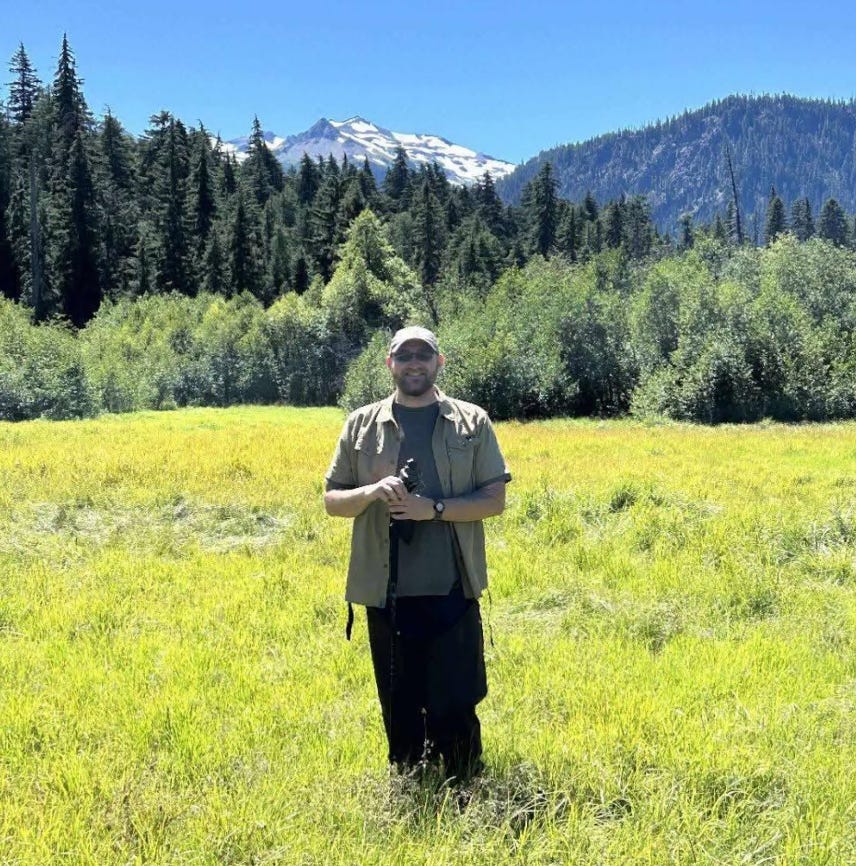
“The greatest delight which the fields and woods minister, is the suggestion of an occult relation between man and the vegetable. I am not alone and unacknowledged. They nod to me, and I to them.”
—Ralph Waldo Emerson, Nature, 1836
Emerson speaks of a subtle dialogue between humanity and the wild, a relationship built on quiet acknowledgment. I have been turning that idea over in my mind since a recent backpacking excursion with friends into the Goat Rocks Wilderness of the Southern Cascade mountains. This search for communion is central to one of my own pursuits: the search for Sasquatch. While the hobby might seem strange to some, it is for me a serious apprenticeship in learning to pay attention. This is the core of transcendentalist practice, as I understand it; Henry David Thoreau’s two years at Walden were an ethical project, an attempt, as he wrote, “I went to the woods because I wished to live deliberately, to front only the essential facts of life, and see if I could not learn what it had to teach.” His goal was a form of wakefulness: “Morning is when I am awake and there is a dawn in me. Moral reform is the effort to throw off sleep.” The following are some musings on that practice, a reflection on how that journey into the wilderness can become a lesson in the value of the search itself.
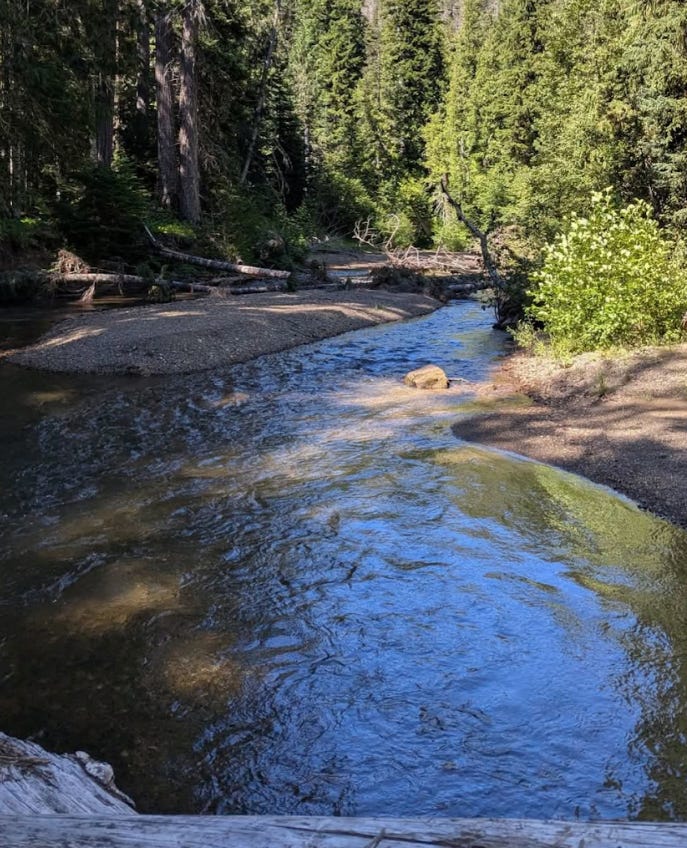
The journey begins with a deliberate separation from the comfortable world. The pack’s weight pressing into the shoulders becomes a physical reminder of commitment; each step away from the trailhead marks a gradual shedding of civilization’s protective numbness. The initial discomfort, the sharp intake of breath on the first incline, and the steady crunch of boots on gravel all become instruments of focus, drawing the mind’s attention back from its scattered anxieties and anchoring it firmly in the body, present in the here and now. This is a first step toward what Thoreau called “an infinite expectation of the dawn.” Within a quarter mile, the first river crossing presents itself, a chaos of sun-bleached logs spanning rushing, albeit low, water. To cross with a full pack demands complete presence: each step a careful negotiation on bark slick with moss and time. One foot placed wrong means a cold swim and ruined gear. This immediate test serves as a guardian to the threshold, a physical challenge that requires a mental shift from casual passage to focused engagement. Beyond the crossing, the trail dissolves into confusion. We meander along an old trail that has not been maintained in nearly a decade only for it to peter out and we find ourselves following only game trails into marshy ground. What appears solid gives way suddenly, plunging boots into black water that smells of decay. We backtrack repeatedly, humbled. The forest will not yield its secrets to those who demand quick passage.
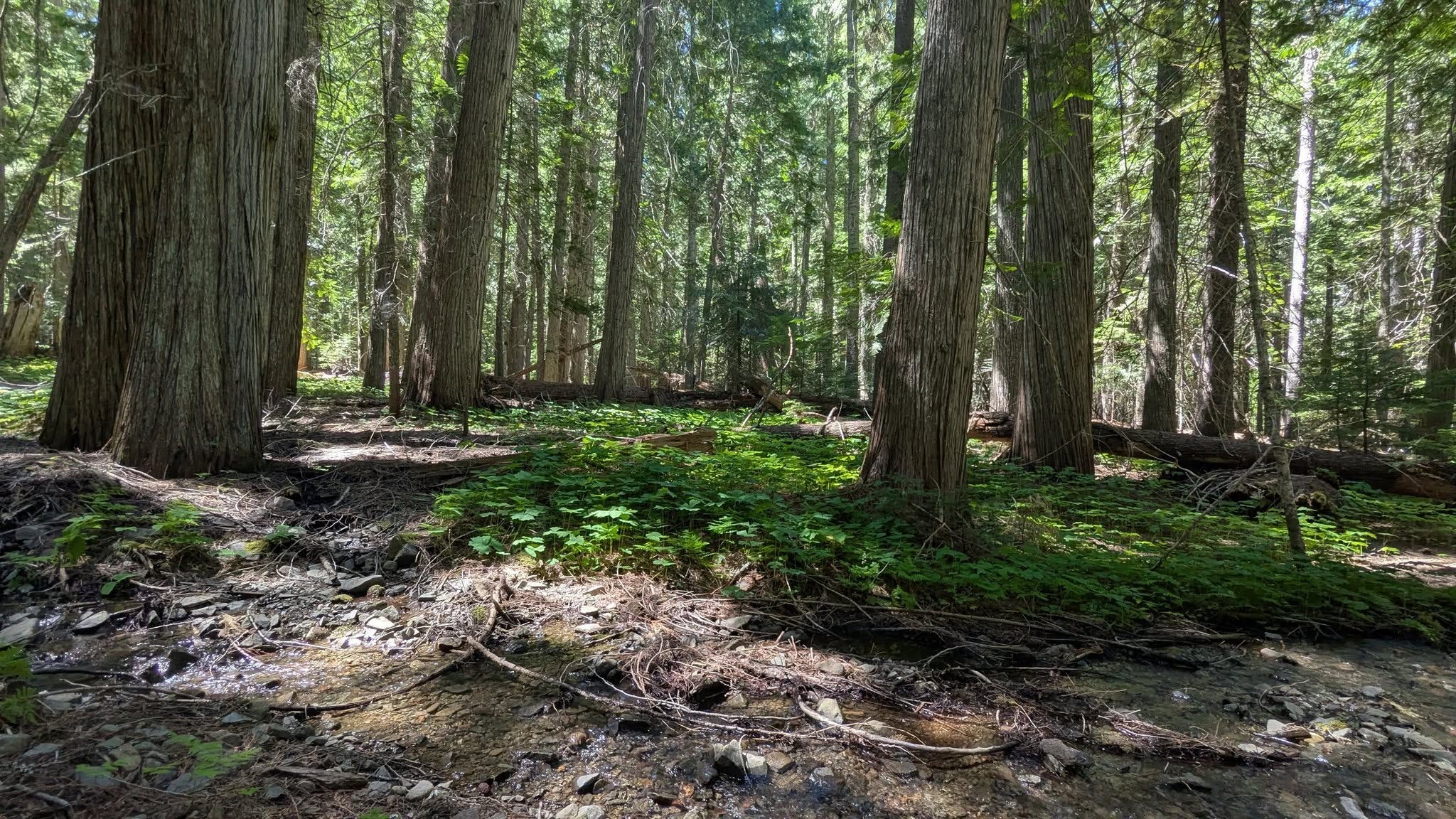
After a half hour of false starts, we find the remnant trail and enter a grove of old cedars. The atmosphere shifts immediately. These trees create a cathedral space where sound dampens and time seems to pool rather than flow. We string our hammocks between trunks whose bark spirals in deep grooves, each groove a century of growth. The creek here speaks constantly, its voice neither rising nor falling but maintaining a steady commentary. But the feeling here is more than just peace. There is a sense of presence, of a watchful intelligence in the grove itself. After establishing camp and a quick lunch, we begin the real work of searching.
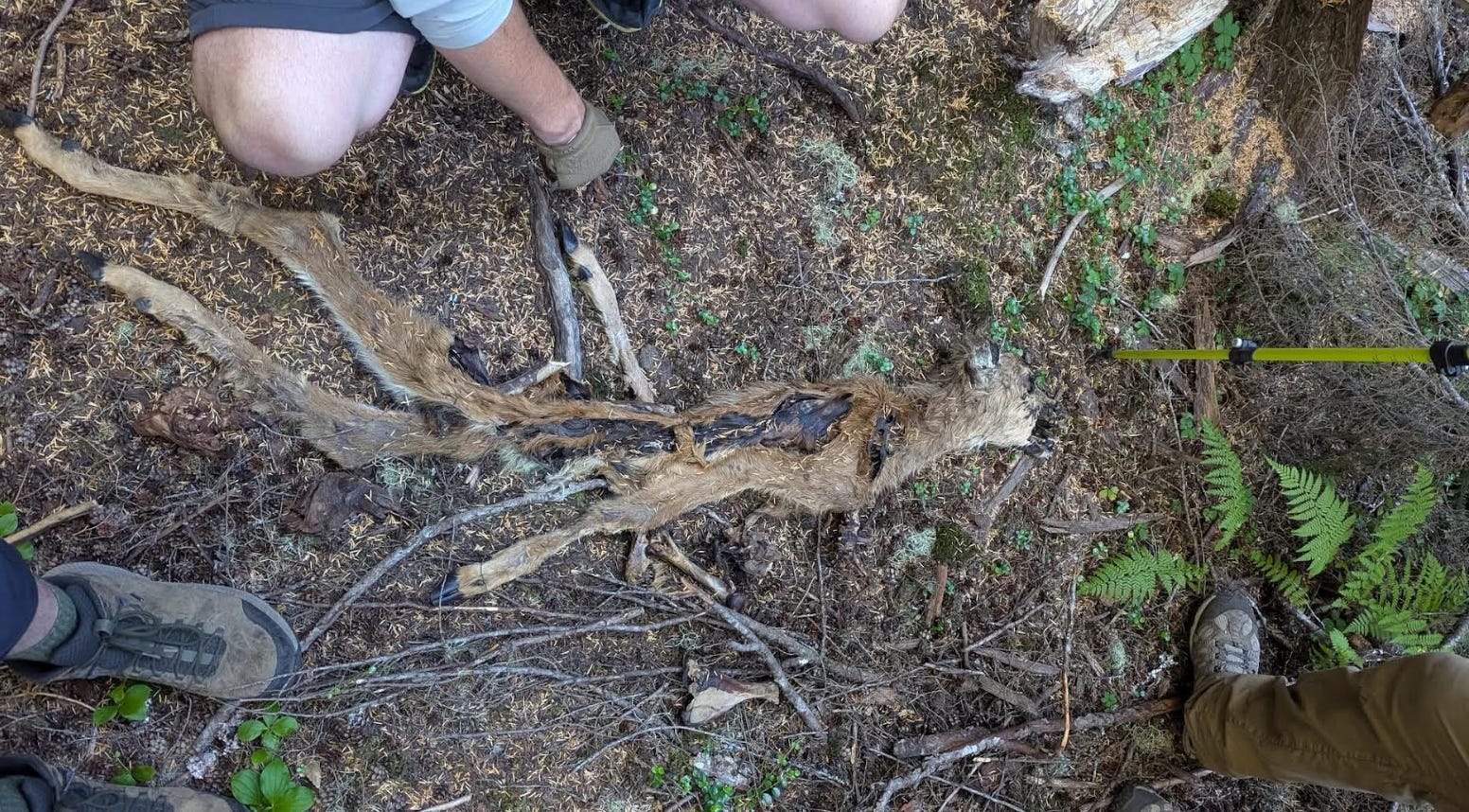
This work requires a different way of seeing, a softening of the focus to take in the periphery, a way of looking that notices movement and pattern rather than fixing on individual details. It is akin to Walt Whitman’s practice: “I loafe and invite my soul, / I lean and loafe at my ease observing a spear of summer grass.” We move slowly through the timber, noting how elk have created highways through the underbrush, how deer beds appear in protected hollows. The forest reveals itself as a text written in multiple languages simultaneously. On a small hill warmed by afternoon sun, we discover what death looks like in the wild. Bones scatter across the forest floor, bleached white and gnawed clean. A young elk’s corpse lies like a broken thing. This is a killing ground, probably a cougar’s preferred spot for consuming prey. The discovery brings a sharp awareness of our position in the food chain. We are participants who could, under different circumstances, join these bones. This, too, is a recognition of the complete cycle, of what Whitman saw everywhere: “To me every hour of the light and dark is a miracle, every cubic inch of space is a miracle.”
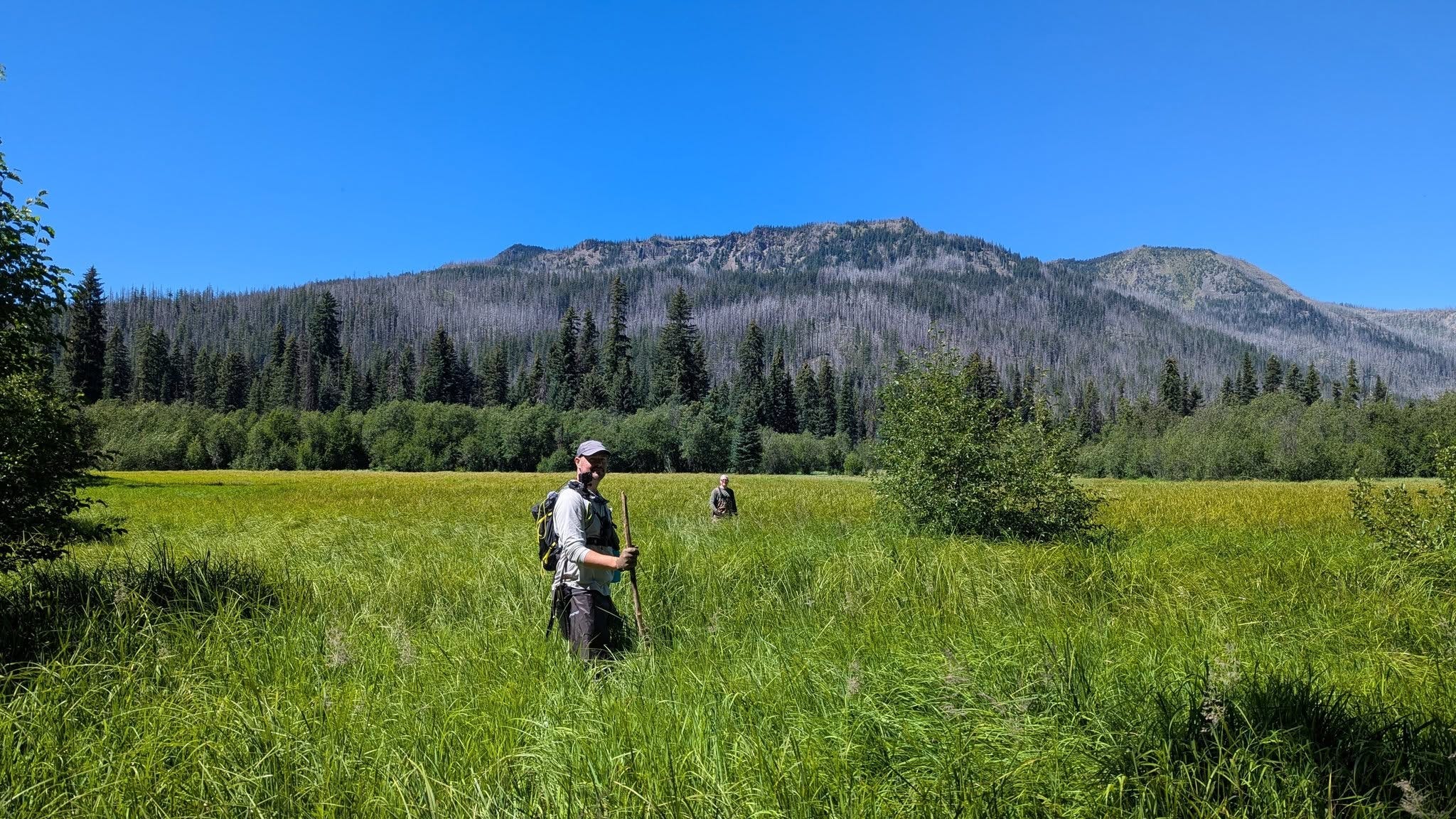
From the bone hill, we descend toward the river, pulling on chest waders for the next phase of searching. The meadow between forest and water appears idyllic from above, waves of grass moving in the afternoon breeze. But each step reveals deception. The ground alternates between solid hummocks and sucking bog that grips the waders with disturbing strength. Skunk cabbage grows in profusion, its broad leaves hiding treacherous holes. We push through, accepting the lesson that beauty and difficulty intertwine inextricably in wild places.
The river itself runs cold and clear, its current strong enough to require careful foot placement. We wade upstream, scanning muddy banks for the distinctive track we seek, a print showing a mid-tarsal break, indicating a flexible foot unknown in other North American fauna. But the river reveals only the expected passages of deer, elk, and raccoon. A great blue heron watches our clumsy progress, lifting off with prehistoric grace when we approach too close. The absence of evidence sharpens attention further. Exiting the river requires battling through a wall of vegetation that seems designed to repel human passage. Devil’s club, aptly named, presents thorns that break off in skin and fester. Stinging nettles create a burning that lasts for hours. We push through this green inferno, accepting the pain as a sort of fee. The bog created by the vegetation barrier is worse than the meadow, a reeking soup of decomposed plant matter that releases methane with each step.
By evening, we return to the cedar camp, scratched, muddy, and exhausted but oddly satisfied. The day’s labor has produced no sighting of our quarry, but it has provided something perhaps more valuable. After a nap and dinner, as darkness falls, we examine the ground around camp more carefully. Fresh cougar tracks cross our entry path, the prints showing the distinctive heel pad and toe arrangement. The cat probably watched our arrival. Near the creek, we find the largest bear scat I have encountered, full of berry seeds. A massive black bear, probably a large solitary male, passed through recently. These discoveries bring both excitement and sobering awareness; we share this space with apex predators who move through darkness with ease while we stumble and crash through underbrush. The recognition enforces humility. As full darkness arrives, we retreat to our hammocks and tents, the world illuminated only by the eerie red glow of our headlamps, a color chosen to preserve our night vision. We set up audio recorders and thermal cameras, panning the dark horizons for any heat signature that does not belong. We send out our own signals: a series of wood knocks that echo through the trees, a few whoops that die in the dense air, even music from a flute and Bluetooth speaker we packed in, all in the hope of sparking the curiosity of any large, unclassified primate that might be within earshot.
But the forest only answers with its own sounds. The creek’s voice contains infinite variations; no two seconds are identical. Occasionally, something large moves through the forest, branches breaking under weight. Once, a sound like a heavy club striking wood echoes from the ridge above. Perhaps an old tree branch falling and hitting a log; no known animal makes such a sound. But uncertainty itself becomes the teacher. To lie in darkness, hearing the unexplained, requires accepting limited knowledge while maintaining open attention. This state of alert unknowing, of listening for a reply from a world a modern mindset has forgotten how to address, is precisely what the transcendentalists sought. It is the practice of wakefulness. Emerson pointed directly to this state of being: “I become a transparent eyeball; I am nothing; I see all; the currents of the Universal Being circulate through me.” In that moment, the boundary between observer and observed dissolves. This is the experience of the Over-Soul, the unity Emerson described where “the act of seeing and the thing seen, the seer and the spectacle, the subject and the object, are one.” Lying in the hammock, I am simply a point of awareness, a channel for the “currents of the Universal Being“ to circulate.
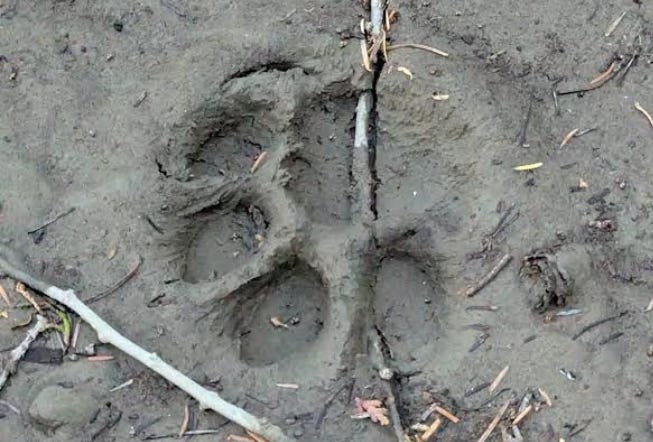
The night brings its own revelations. Around midnight, clouds clear and stars appear in gaps between cedar boughs. The Milky Way streams across the sky, a river of light echoing the water’s sound below. To witness this while lying in the forest’s embrace is to experience directly what civilization’s barriers normally prevent, the recognition of participation in something vastly larger than individual existence. Dawn arrives slowly in the cedar grove, light filtering green through the canopy before touching the forest floor. Over coffee, we talk and explore the immediate area one last time. At the river crossing, we find fresh tracks in the mud, the prints of many animals who came to drink in darkness while we slept. Among them, one set remains ambiguous, deeper than deer, different from bear, worth photographing and pondering: yet nothing conclusive or worth getting overly excited over.
The journey out reverses the journey in, but with important differences. The pack feels lighter despite its largely unchanged weight. We do not get lost on the meandering game trails, having flagged and marked out path in. The river crossing that challenged our balance yesterday now seems straightforward. Most significantly, the quality of attention cultivated in the forest persists. This education in seeing transfers to other domains. Returning to the city, the same attention that noticed disturbed duff in the forest now perceives subtle social dynamics in coffee shops and meeting rooms. The patience developed while waiting for wildlife serves equally well when listening to a friend work through difficulty. The acceptance of ambiguity practiced with unclear tracks helps navigate the uncertainties of modern life. This new perspective is what Emerson meant when he wrote of the lover of nature: “His intercourse with heaven and earth becomes part of his daily food.”
But perhaps the deepest teaching concerns the nature of the search itself. Seeking Sasquatch becomes a practice in maintaining openness to mystery while applying rigorous observation. Each expedition builds evidence through absence as much as presence. The lack of clear tracks in areas of reported sightings provides data as valuable as finding them would be. This paradox, that absence teaches as much as presence, applies broadly. The soreness that lingers for days after such journeys serves as a physical memory, proof of genuine engagement with the world beyond screens and pavement. Muscles record the effort of climbing over deadfall, wading rivers, and pushing through brush. But more than physical effort, they record the price of transformation. For the wilderness does transform those who enter it properly prepared to receive its teachings, not through dramatic revelation but through the slow accumulation of adjusted perception. The ultimate value of searching for hidden creatures lies in the transformation of the seeker. Each expedition deepens the capacity to perceive beauty where, as Thoreau noted, “Beauty is where it is perceived”; it is the work he described as “To affect the quality of the day, that is the highest of arts.” These lessons matter because they address what civilization increasingly obscures: our embedded participation in the living world.
The search reconnects us to older ways of knowing, ways that recognize intelligence in the forest’s ability to hide its secrets, wisdom in the water’s patient carving of a canyon, and teaching in the cougar’s invisible presence. Perhaps this explains the persistence of the search despite decades without definitive proof. The practice itself provides what consumer culture cannot: direct engagement with mystery, physical challenge that serves spiritual development, and patient observation that trains deeper seeing. The creek beside which we camped continues its ancient conversation, wearing away stone particle by particle, carrying mountain to sea in a process too slow for human perception but inevitable as gravity.
This is the final teaching, that wisdom moves at the pace of geological time, not human urgency. Those who would learn from wilderness must adjust their temporal expectations, must learn to measure success not in dramatic discoveries but in the gradual refinement of perception. The search continues because the searching itself succeeds in ways the seeker only gradually comes to understand. And in that gradual understanding lies the real quarry, the hidden creature we actually seek, which is our own capacity to perceive the extraordinary nature of the world as it actually exists, waiting not to be discovered but to be recognized by eyes patient enough to see.
"And in that gradual understanding lies the real quarry, the hidden creature we actually seek"
A "questing beast" perhaps?